kelley@u-kitchenwares.com
+86-15819924651
+86-0750-3719388

The best quality cooking pots combine suitable material grades, consistent wall thickness, stable bases, secure handles, accurate lids, and smooth finishing. Buyers should evaluate actual construction and sample performance rather than relying on appearance or price alone.
A high-quality cooking pot should perform consistently under its intended cooking conditions.
Its construction must support normal heating, handling, cleaning, and storage without unnecessary deformation or component failure.
For cookware manufacturers and distributors, quality involves several connected factors:
Material selection.
Body and base construction.
Forming accuracy.
Handle attachment.
Lid fit.
Surface finishing.
Heat-source compatibility.
Inspection and packaging.
A polished exterior may improve product presentation, but it does not automatically indicate a well-manufactured cooking pot.
Stainless steel grade is one of the first specifications to confirm.
304 Stainless Steel
304 stainless steel is widely used in cooking pots because of its good corrosion resistance and suitability for many food preparation applications.
It is a common choice for buyers seeking a balance between material performance and everyday maintenance.
201 Stainless Steel
201 stainless steel can be used for selected cookware products where cost is an important consideration.
However, its corrosion resistance is generally lower than 304, so the intended environment and cleaning conditions should be considered.
430 Stainless Steel
430 stainless steel has magnetic properties and may be used in selected cookware structures, including certain base or outer-layer applications.
The correct choice depends on the product design and intended use.
A reliable supplier should identify the actual material grade of the pot body, lid, and base components.
Body thickness influences structural rigidity, weight, forming, and resistance to deformation.
A pot that is too thin for its intended application may become distorted more easily during handling or heating.
However, thicker material is not automatically better.
Excessive thickness can increase product weight, material cost, and handling difficulty.
The appropriate thickness should match the pot's diameter, depth, capacity, base structure, and intended cooking method.
For commercial cookware buyers, consistency across the same production batch is just as important as the nominal thickness.
The base is responsible for transferring heat from the cooktop to the food.
Stainless steel provides corrosion resistance but conducts heat less efficiently than aluminum.
For this reason, some stainless steel cooking pots use composite bases with an aluminum layer.
The aluminum layer helps distribute heat across the bottom, reducing the concentration of heat in one area.
During product evaluation, check:
Base thickness.
Number of layers.
Material composition.
Flatness.
Bonding quality.
Induction compatibility.
Stability on the intended cooktop.
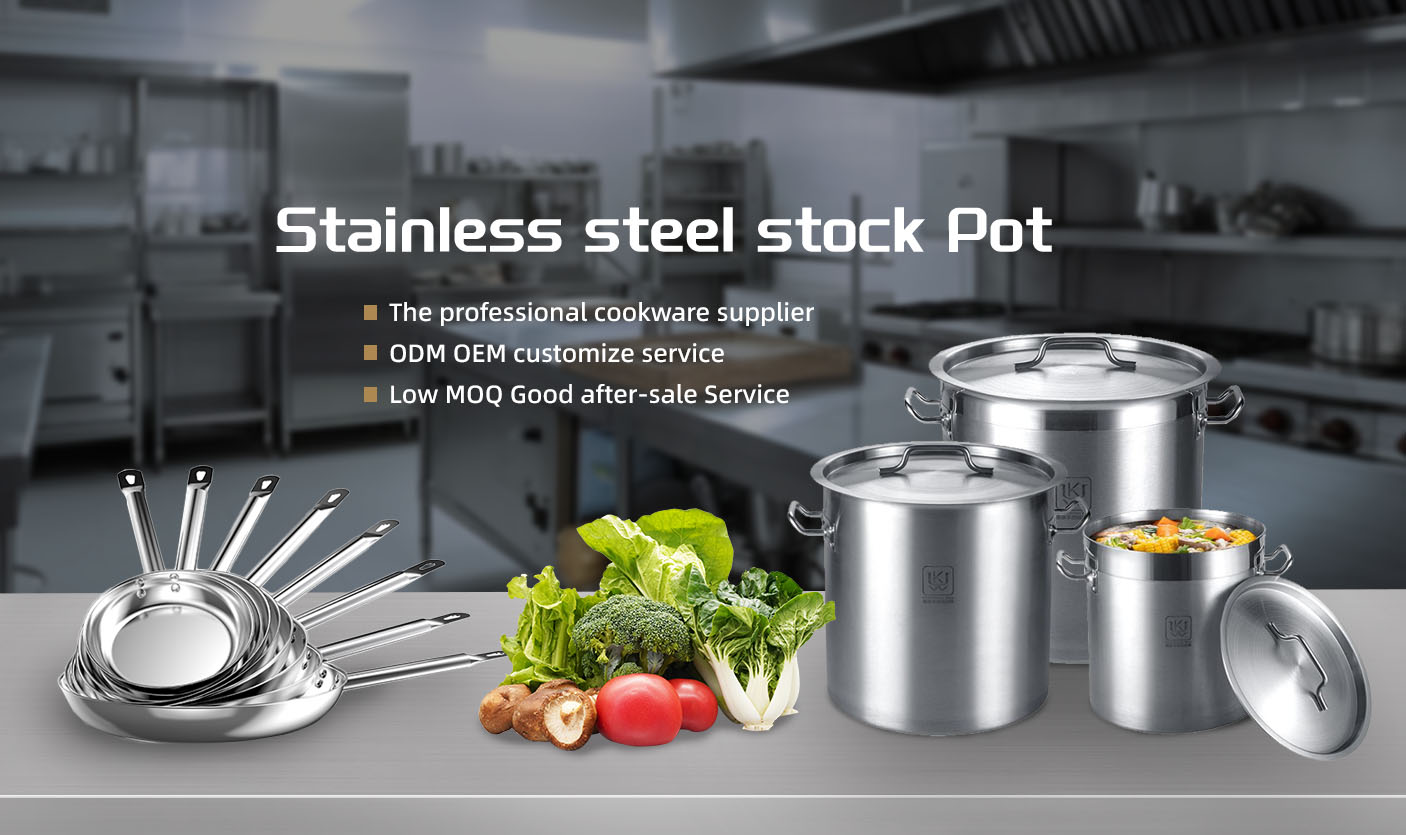
Our listed stainless steel stockpot series includes models with three-layer composite bottoms.
The exact base construction should be confirmed for each selected model rather than assumed across the entire product range.
Handles and lids are important because they are used repeatedly during cooking.
Handle Attachment
Handles should be securely attached to the pot body.
Buyers should inspect rivets, welds, connection points, and the surrounding metal for visible defects.
Handle Shape
The handle should provide a practical grip and suitable clearance from the pot body.
Lid Fit
A matching lid should sit evenly on the rim without excessive movement.
Lid Handle
The lid handle should be securely fixed and comfortable to use.
Rim Finishing
The pot rim should be smooth and consistently formed to support safe handling and a neat appearance.
These details are particularly important when selecting cooking pots for retail brands and commercial kitchenware collections.
A physical sample provides a better indication of construction quality than product photographs.
A useful inspection sequence includes:
Measure the pot diameter, height, capacity, and handle position against the approved drawing.
Check the material specification and look for scratches, uneven polishing, or visible manufacturing defects.
Place the pot on a flat surface and check for rocking or visible distortion.
Check whether the handles are securely attached and whether the pot feels balanced when lifted.
Confirm that the lid matches the rim and can be placed and removed conveniently.
Review the pot body, base, rim, handles, and lid together rather than judging each component separately.
For a sample intended for performance testing, the test conditions should match the product's rated use and safety requirements.
A professional cookware manufacturer should be able to explain the material, thickness, construction, and available customization options.
For bulk purchasing, buyers should request:
Material specifications.
Product drawings.
Capacity and dimensional information.
Base construction details.
Handle attachment methods.
Surface finishing options.
Sample approval arrangements.
Inspection standards.
Packaging specifications.
Replacement component support.
MEIJIN manufactures Stainless Steel Stockpots and other kitchenware for international distributors, retailers, and commercial kitchen equipment suppliers.
Our factory is located in Jiangmen, Guangdong, and covers approximately 10,000 square meters, with independent production workshops and product development support.
Our team also provides OEM and ODM cooperation for customized cookware requirements.
For more supplier evaluation guidance, see our article on how to evaluate a stainless steel kitchenware manufacturer.
The Stainless Steel Stockpot Product Range provides examples of different pot structures and capacities.
The best quality cooking pots are identified through material verification, structural inspection, sample testing, and consistent production specifications.
Our manufacturing team works with cookware wholesalers, importers, retailers, and private-label brands to discuss stainless steel cooking pot requirements.
Share your preferred pot capacity, material grade, body thickness, base structure, handle design, and estimated quantity through our Cooking Pot Inquiry Page to discuss product specifications and OEM/ODM manufacturing.
Previous:
Next: Best Cookware To Buy