kelley@u-kitchenwares.com
+86-15819924651
+86-0750-3719388

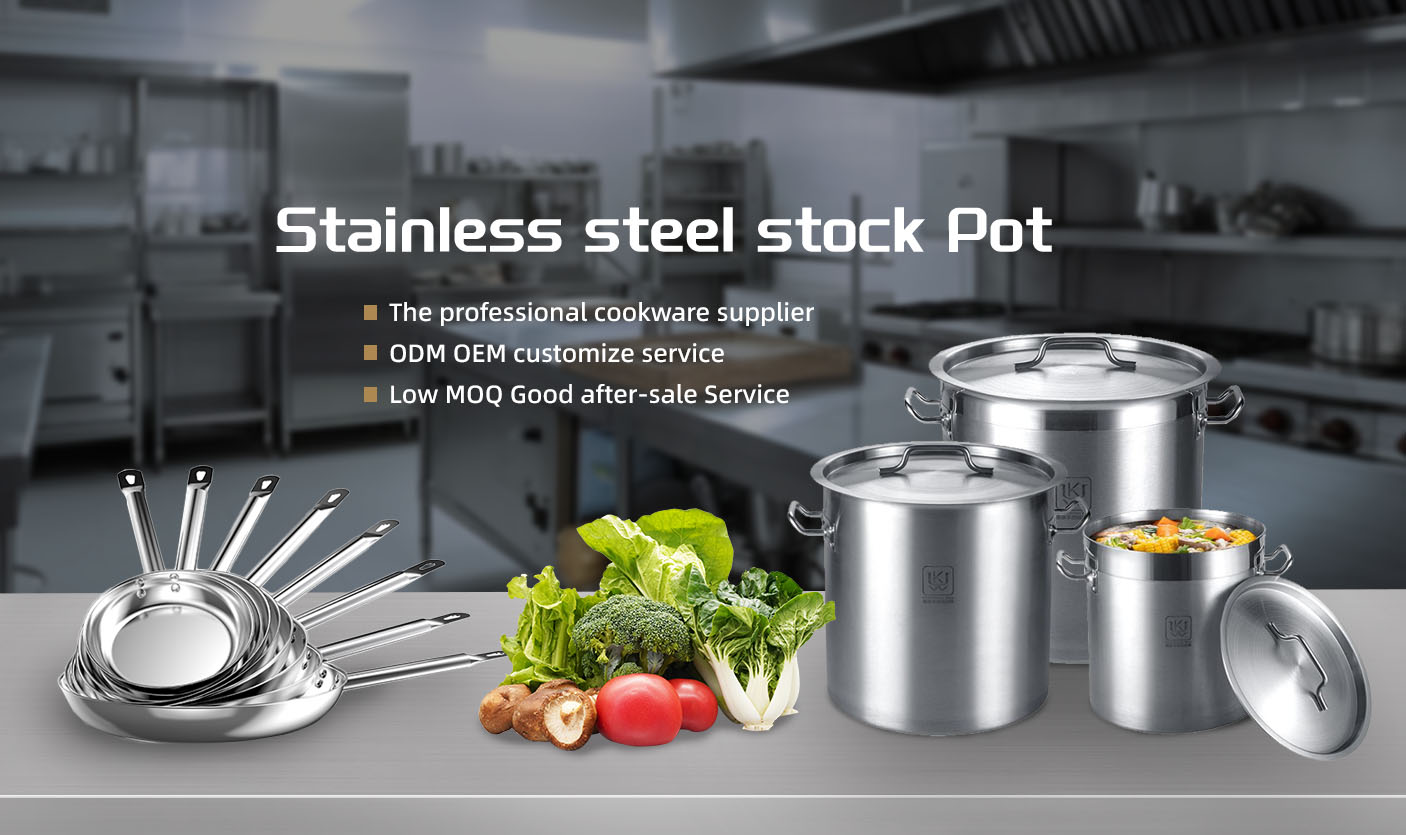
A stockpot is a tall, deep cooking vessel designed for preparing large quantities of liquid-based food. Its high sides and large capacity make it suitable for stocks, soups, broths, pasta, blanching, and batch cooking.
A stockpot is commonly used in household kitchens, restaurants, hotels, catering facilities, and central food production kitchens.
Its main purpose is to accommodate larger cooking volumes without requiring an excessively wide cooking surface.
Typical applications include:
Preparing chicken, beef, and vegetable stock.
Cooking soups and broths.
Boiling pasta and noodles.
Preparing seafood and shellfish.
Blanching vegetables.
Cooking large batches of sauces.
Preparing food for catering events.
For professional kitchens, a stockpot is particularly useful when the same recipe needs to be prepared repeatedly in larger quantities.
The shape of a stockpot is closely related to its intended cooking tasks.
Tall Sidewalls
The tall body provides a larger liquid capacity while keeping the footprint relatively compact.
This is useful when preparing large quantities of soup or broth.
Wide Opening
The opening provides access for adding ingredients, stirring, and removing food.
It also makes cleaning easier after cooking.
Flat Base
A stable base helps the pot sit securely on the cooking surface.
The base structure influences heat distribution and compatibility with different cooktops.
Side Handles
Stockpots commonly use two side handles because their contents can become heavy when filled with liquid and ingredients.
Handle strength and attachment quality are important purchasing considerations.
Matching Lid
A lid helps reduce heat and moisture loss during cooking.
A properly fitted lid should sit securely on the pot rim without being difficult to remove.
A stockpot and a saucepan both have relatively deep bodies, but their capacities and intended uses differ.
A stockpot is generally taller and larger, making it suitable for preparing substantial quantities of liquid-based food.
A saucepan is usually smaller and is better suited to sauces, heating liquids, cooking grains, and preparing smaller portions.
The selection should depend on cooking volume, burner size, and the frequency of batch preparation.
For a deeper comparison, see our guide on Stock Pots vs. Sauce Pots.
Stainless steel is widely used in stockpot manufacturing because it offers corrosion resistance, practical cleaning characteristics, and suitability for repeated kitchen use.
However, different grades and base constructions serve different purchasing requirements.
304 Stainless Steel
304 stainless steel is commonly selected for cookware requiring good corrosion resistance and everyday food preparation performance.
201 Stainless Steel
201 stainless steel can be used for selected cookware products where cost and operating conditions are important considerations.
430 Stainless Steel
430 stainless steel has magnetic properties and may be used in selected cookware structures and external components.
The material grade should be confirmed for the pot body, lid, and other components rather than assumed from the product's exterior appearance.
The base is one of the most important structural components of a stockpot.
A suitable base should provide stable contact with the cooking surface and support effective heat transfer.
Some Stainless Steel Stockpots use a multi-layer composite base containing an aluminum layer.
Aluminum helps distribute heat because it conducts heat more effectively than stainless steel alone.
For example, our listed stainless steel stockpot range includes models with a three-layer composite bottom structure.
The product specifications vary according to model size and construction.
Buyers should check the base material, layer structure, thickness, and cooktop compatibility before placing an order.
Capacity should match the quantity of food prepared during each cooking cycle.
A small restaurant preparing sauces and soup for limited daily service may not need the same stockpot capacity as a catering kitchen preparing hundreds of portions.
When selecting a stockpot, consider:
Expected cooking volume.
Type of food being prepared.
Required headspace.
Available burner size.
Filled weight and handling.
Storage space.
Cleaning requirements.
Our listed stockpot models cover capacities from 6L to 170L across different sizes.
The exact capacity and dimensions should be confirmed for the selected model.
For cookware distributors and commercial kitchen equipment suppliers, product quality depends on the complete construction.
Check the material grade, body thickness, base structure, handle attachment, lid fit, rim finishing, and packaging.
During sample evaluation, a stockpot should be inspected both empty and under an appropriate test load.
Handle connections, base stability, and lid alignment deserve particular attention.
MEIJIN manufactures stainless steel stockpots for household kitchens, restaurants, and commercial foodservice markets.
Our factory supports different stockpot capacities and selected customized specifications for international buyers.
View our Stainless Steel Stock Pot product range to compare available models.
Choosing a stockpot involves more than comparing nominal capacity. Material, base construction, handle design, and actual cooking requirements all influence the final product selection.
Our team works with cookware wholesalers, restaurant equipment suppliers, importers, and private-label brands to discuss stainless steel stockpot manufacturing.
Provide your preferred capacity, dimensions, material, base structure, and estimated purchasing quantity through our Stockpot Inquiry Page to discuss product specifications and bulk orders.
Previous: