kelley@u-kitchenwares.com
+86-15819924651
+86-0750-3719388

Commercial buyers should choose a Chafing Dish by matching capacity, pan configuration, lid design, heating method, materials, and maintenance requirements to the intended foodservice operation. Clear specifications and sample approval help reduce sourcing risks.
Start by identifying who will use the chafing dish and how it will be used.
A hotel breakfast buffet, a wedding caterer, and a restaurant supply distributor may all need chafing dishes, but their purchasing priorities can differ.
A hotel may value a consistent appearance across a large buffet line. A mobile caterer may prioritize foldable frames and compact storage. A distributor may need several sizes and configurations to serve different customer groups.
Before requesting quotations, establish:
Target customer and intended application.
Food types and serving volume.
Expected service duration.
Available counter or table space.
Preferred heating method.
Storage and transport requirements.
Destination market and applicable requirements.
These details help narrow the product range before time is spent comparing individual models.
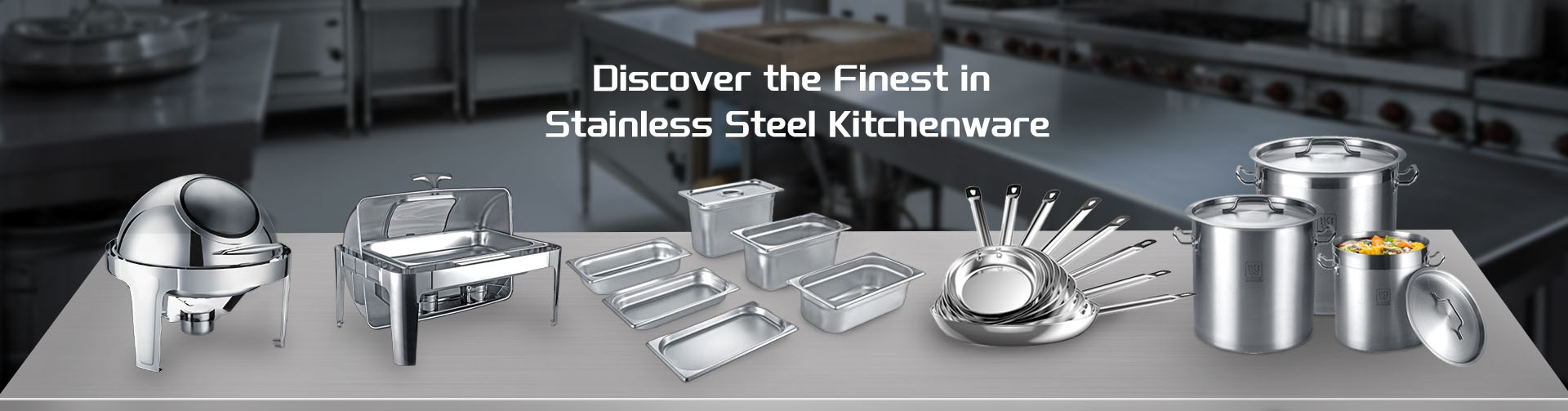
MEIJIN's Chafing Dish collection includes different product configurations for commercial buffet and catering applications.
Capacity affects how much food can be held, while pan configuration determines how the food is arranged and replenished.
A single large food pan can be suitable for a main dish or a popular buffet item. Two smaller pans may provide more flexibility when the menu contains separate dishes.
However, nominal capacity should not be the only criterion. The overall footprint and the available space for serving and refilling are equally important.
For example, MEIJIN's listed 9L foldable model is available with either one 1/1 food pan or two 1/2 food pans, depending on the model. Its listed dimensions are 580 × 360 × 320 mm.
The 9 Liter Foldable Chafing Dish is a useful reference when comparing capacity, divided pans, and storage needs.
For project orders, ask the supplier to confirm the exact model number, dimensions, pan arrangement, and included accessories. Similar-looking products should not be assumed to have interchangeable parts.
Shape affects the way food is presented and how efficiently the serving area is organized.
Rectangular or oblong units can suit long buffet counters, while round models may work well in smaller serving areas or layouts that use circular arrangements.
Lid style also affects daily use.
Roll-top lids remain attached while opening, which can make self-service more convenient.
Lift-off lids can provide straightforward access for refilling and cleaning, but staff need a suitable place to put the lid during service.
Foldable frames can help catering companies reduce storage space between events.
The best configuration depends on how often the dish is opened, who serves the food, and how much space is available around the unit.
MEIJIN's 6L Commercial Round Chafing Dish offers a specific round format with a 180-degree roll-back lid. Its published dimensions and pan details should be used when planning a layout around this model.
Chafing dishes commonly use fuel burners or electric heating, depending on the product design.
Traditional fuel-heated units generally use a water pan between the heat source and food pan. Electric models use a compatible electrical heating system.
Before ordering, confirm which components are included.
The quotation should clarify whether the product includes the lid, food pan, water pan, frame, fuel holders, or electric heating components. It should also identify any accessories that need to be purchased separately.
For hotels and catering companies, the heating method should suit the site and the applicable operating requirements.
For distributors, accurate component lists are especially important because an incomplete product description can lead to customer complaints, additional shipping costs, or delays when missing parts need to be supplied.
Material specifications influence durability, appearance, cleaning, and cost.
Stainless steel is a common choice for commercial chafing dishes, but different grades and construction details can affect the finished product.
Buyers should confirm the actual steel specification rather than relying on a general statement such as premium stainless steel.
Other points to review include:
Material thickness where specified.
Surface finish and consistency.
Lid alignment and operation.
Frame stability and connection quality.
Handle design and edge finishing.
Food pan fit and removal.
Compatibility of heating components.
Polished surfaces should be checked for scratches, uneven finishing, and visible defects. Frames should sit stably on a level surface, and moving parts should operate as intended.
For a larger order, the approved sample should become the reference for appearance, dimensions, and construction.
The cost of a chafing dish does not end with the purchase.
Frequent cleaning, handling, storage, and replacement of damaged components all affect the product's long-term value.
A design with removable pans may be easier to wash. A foldable frame may reduce storage requirements for event suppliers. Replaceable lids and other components can help keep the remaining equipment in service if one part is damaged.
Before placing an order, ask about:
Recommended cleaning procedures.
Parts that can be removed for washing.
Storage and stacking requirements.
Replacement lids and food pans.
Burner or heating-component availability.
Packaging protection during transport.
MEIJIN's article on how to choose stainless steel restaurant supply chafing dishes provides additional guidance on capacity, shape, and the practical requirements of buffet service.
For importers and wholesalers, a suitable product must be supported by a reliable manufacturing and supply process.
Supplier evaluation should cover relevant product experience, sample approval, specification control, production inspection, packaging, and communication about changes.
MEIJIN specializes in stainless steel kitchenware and buffet products, including chafing dishes, GN Containers, stock pots, trolley carts, and beverage dispensers. Its company profile provides information about its product focus, manufacturing resources, and OEM/ODM services.
For a commercial order, buyers should still confirm the specific capabilities relevant to the selected product.
Ask how incoming materials are checked, how finished dimensions and appearance are inspected, and how approved samples are used to control repeat production.
If the project requires particular product tests or compliance documents, identify those requirements before the order is finalized.
A useful quotation comparison covers more than unit price.
Two chafing dishes may have similar appearances but differ in capacity, steel specification, lid mechanism, included accessories, packaging, or customization.
| Purchasing Item | What to Confirm |
|---|---|
| Model and capacity | Exact model number, nominal capacity, and dimensions |
| Material | Steel grade, thickness where applicable, and surface finish |
| Included parts | Food pan, water pan, lid, frame, and heating accessories |
| Customization | Logo, finish, dimensions, or packaging changes |
| Sample | Availability, approval process, and any sample charges |
| Quality control | Inspection criteria and required documentation |
| Packaging | Individual protection, carton dimensions, and shipping suitability |
| Order terms | Quantity, production schedule, delivery terms, and repeat-order arrangements |
For private-label brands, artwork, logo placement, packaging design, and product labeling should be approved before mass production.
This reduces the risk of receiving products that are technically acceptable but do not match the brand's presentation or packaging requirements.
A clear request for quotation helps the manufacturer assess the requirement without repeated clarification.
Include the intended application, target capacity, preferred shape, lid style, heating method, material requirements, quantity, and destination market.
If the order is based on an existing model, provide its product reference. For customized orders, include drawings, reference photographs, logo artwork, or packaging specifications where available.
Also identify the required delivery schedule and any inspection or documentation requirements.
The more complete the brief, the easier it becomes to compare quotations and establish an agreed specification for production.
MEIJIN supplies chafing dishes and related buffet equipment for commercial foodservice buyers, importers, distributors, and catering businesses.
To discuss a suitable product, share your target capacity, dimensions, pan configuration, heating method, material preferences, branding needs, and estimated order volume. The team can then review the available models and the scope of any customization.
Start with the MEIJIN Chafing Dish product range and prepare a specification that matches your customers' service requirements.
Previous:
Next: What Are Chafing Dishes, and How Do You Choose the Best One?