kelley@u-kitchenwares.com
+86-15819924651
+86-0750-3719388

Commercial kitchenware includes the cookware, food containers, preparation tools, holding equipment, transport carts, and serving products used in restaurants, hotels, cafeterias, bakeries, catering companies, and institutional kitchens. The main types of commercial kitchenware are designed around specific stages of foodservice: preparation, cooking, storage, transport, holding, display, and cleaning.
Unlike household utensils, commercial kitchen equipment is selected for repeated use, larger batches, standardized workflows, and compatibility with other equipment. Material, capacity, construction, cleaning access, and replacement availability are therefore as important as appearance.
Commercial cookware is used for boiling, simmering, sautéing, frying, steaming, and batch cooking.
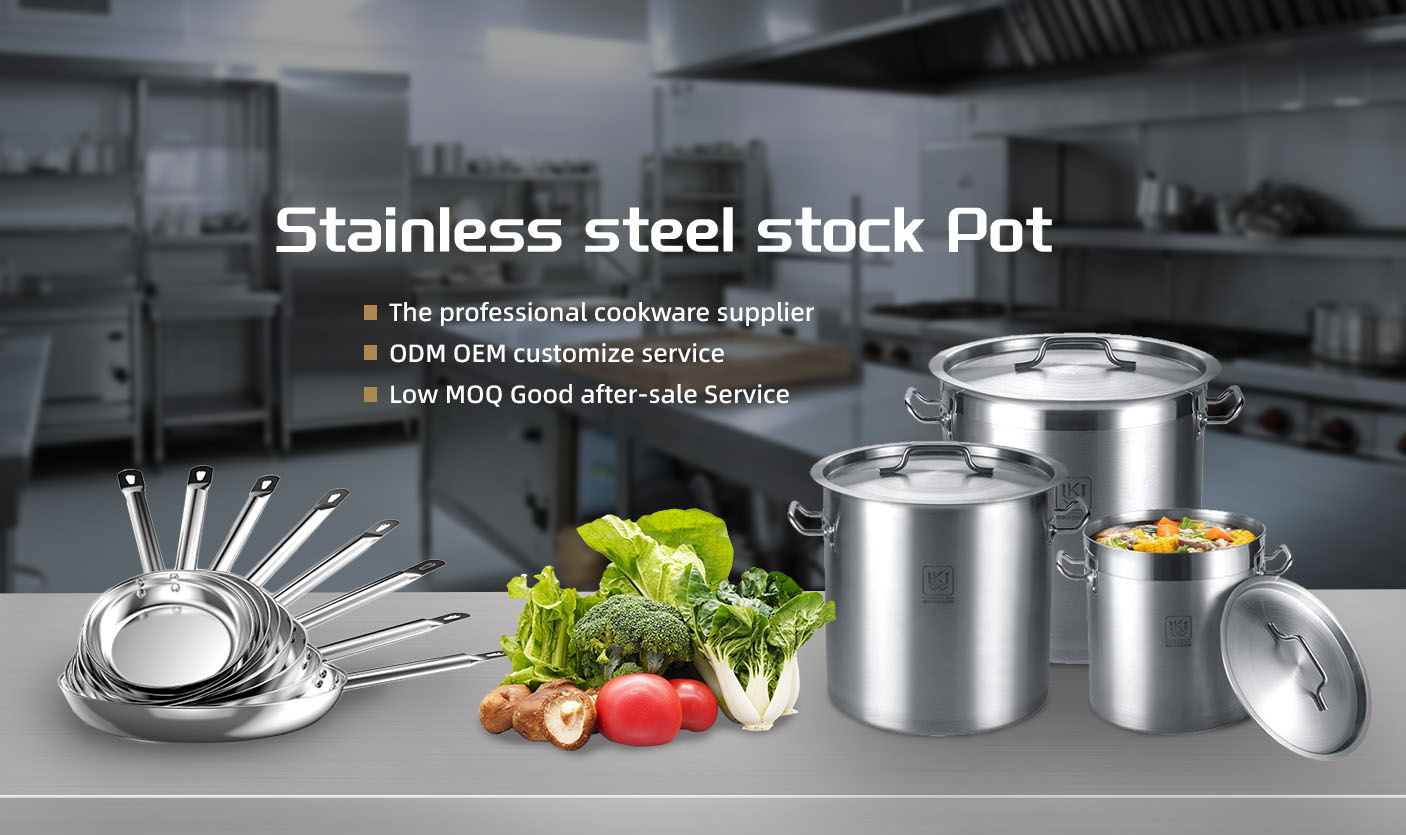
A stock pot is a tall, large-capacity vessel intended for soups, stocks, broths, pasta, vegetables, and other liquid-heavy recipes. Its deeper body helps contain a large volume without requiring excessive floor or burner space.
Professional buyers should compare:
Usable capacity
Body and base construction
Handle attachment
Lid fit
Filled lifting weight
Compatibility with the intended heat source
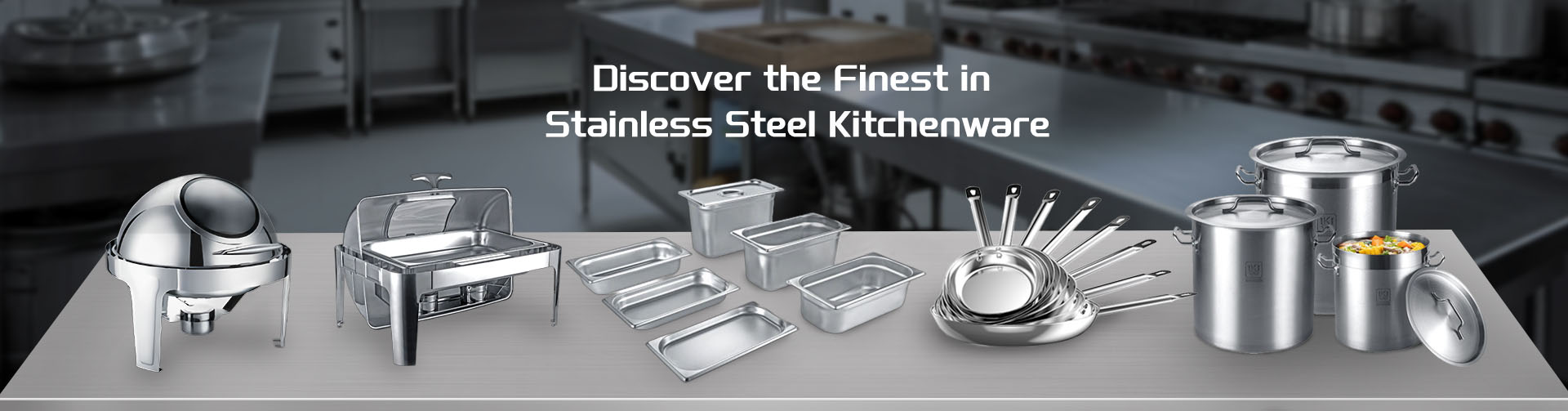
Our stainless steel stock pot range includes different sizes and configurations for commercial food preparation.
Sauce pots have a lower or more moderate height-to-diameter ratio than stock pots. Their wider access makes stirring, reduction, portioning, and evaporation easier.
They can be used for sauces, gravies, custards, stews, reheating, and smaller batches of soup. A commercial kitchen may need both stock pots and sauce pots because their shapes support different cooking processes.
Frying pans provide a broad cooking surface for searing and shallow frying. Griddle pans and comals are useful for products that benefit from direct contact with a heated surface.
Brewing pots, strainer pots, and other specialty vessels add features for a defined process. Buyers should confirm that every component—including handles, lids, strainers, and taps—is suitable for the intended temperature and load.
Professional kitchens depend on standardized food containers to organize ingredients and reduce unnecessary transfers.
Gastronorm, commonly abbreviated as GN, is a modular sizing system used in many commercial kitchens. GN pans can fit compatible preparation counters, racks, refrigerators, ovens, trolleys, and buffet equipment.
Common fraction sizes include GN 1/1, 1/2, 1/3, 1/4, 1/6, and 1/9. Depth is specified separately, allowing a kitchen to combine pans for different menu items within a standardized footprint.
Steam table pans are widely used in North American foodservice for preparation, hot holding, and serving. Although they may look similar to European GN pans, dimensional details can differ.
A buyer should verify the top dimensions, depth, corner radius, rim profile, and equipment fit before treating the two systems as interchangeable.
Solid pans hold liquids, sauces, prepared foods, and general ingredients. Perforated pans allow steam or liquid to pass through, making them useful for steaming, washing produce, draining cooked foods, or keeping ingredients above collected liquid.
Hole size and layout affect both drainage and product retention. Small ingredients may require a finer perforation pattern.
Cooking and serving are not always performed at the same time. Hot-holding equipment helps reduce temperature loss between these stages.
Chafing dishes are commonly used at buffets, hotels, banquets, and catered events. They generally hold a food pan over a controlled heat source or heated water pan.
A chafing dish is intended primarily for holding prepared food, not for cooking raw ingredients. Operators should continue monitoring food temperatures according to applicable food-safety procedures.
Soup kettles are suitable for holding soups, curries, sauces, and similar foods. Round and rectangular food warmers can support different buffet layouts.
Important purchasing details include working capacity, heating method, control range, lid style, pan compatibility, and cleaning access.
Juice dispensers and beverage containers provide organized self-service at breakfast stations, buffets, and events. The tap, reservoir, lid, cooling arrangement, and drip tray should be easy to disassemble and clean.
Insulated barrels and food containers help slow temperature change during holding or transport. They do not replace active refrigeration, heating, or temperature monitoring, but they can support a controlled catering workflow.
Transport equipment should be selected according to:
Food type
Holding time
Filled weight
Vehicle conditions
Lid security
Handle design
Cleaning requirements
Liquids demand greater attention to closure and stability than dry foods. A lid should not be assumed leakproof unless the product is specifically designed and tested for that function.
Tray trolleys, serving carts, collecting carts, cake carts, and flat carts reduce manual carrying between preparation, service, and washing areas.
A commercial trolley should be evaluated by its total rated load, shelf spacing, caster construction, brake arrangement, turning space, and stability. The real operating load includes trays, dishes, food, and accessories—not only the empty cart.
Our product range includes stainless steel tray trolleys and serving carts for different foodservice workflows.
Stainless steel is widely used for commercial kitchenware because it offers a cleanable surface, structural strength, heat resistance, and corrosion resistance appropriate to many foodservice applications.
Performance still depends on the selected grade, thickness, forming quality, welds, edge finishing, and maintenance. Stainless steel is corrosion-resistant rather than completely immune to corrosion. Chloride-rich cleaners, prolonged salt exposure, metal contamination, and poor rinsing can damage its protective surface.
Before placing an order, record:
Intended food and process
Required capacity and dimensions
Stainless steel grade
Body and base construction
Compatible lids and accessories
Temperature and heat-source requirements
Cleaning method
Stackability or nesting requirements
Packaging quantity
Replacement and repeat-order needs
For multi-category procurement, working with a commercial kitchenware wholesale supplier can simplify specifications across cookware, food pans, buffet products, insulated containers, and carts.
Our factory manufactures Stainless Steel Stock Pots, sauce pots, GN containers, us steam pans, chafing dishes, soup kettles, beverage dispensers, barrels, buckets, and commercial trolleys. Our product-development, mold-making, forming, assembly, inspection, and packaging processes support both standard purchasing and project-specific requirements.
The principal types of commercial kitchenware include cookware, food containers, buffet equipment, insulated products, beverage dispensers, and transport carts. Each category solves a different part of the foodservice workflow.
The most reliable selection method is to map every product to its actual task. Capacity, equipment compatibility, cleaning access, construction, and handling safety should be confirmed before price comparisons begin.