kelley@u-kitchenwares.com
+86-15819924651
+86-0750-3719388

Single vs double tray trolleys differ mainly in width, tray capacity, turning space, and the way they move through a commercial kitchen. A single-line tray trolley has one vertical row of tray supports, while a double-line tray trolley carries two rows within one frame.
A double-line trolley can move more trays per trip, but higher capacity does not automatically mean greater efficiency. Narrow corridors, crowded preparation areas, elevator dimensions, and staff handling all influence which configuration works better.
A single-line tray trolley has a narrower body and is generally easier to guide through confined spaces. It may work better in kitchens where staff need to pass between preparation benches, cooking equipment, washing stations, and service doors.
Single-line models are useful for:
Narrow kitchen aisles
Smaller food-preparation areas
Short transportation routes
Lower tray volume per service period
Frequent direction changes
Locations with restricted storage space
Because the trolley carries one column of trays, staff can access each level from a clearly defined side. The compact footprint can also make cleaning and storage easier when floor space is limited.
Our stainless steel single-line tray trolley is constructed as a multi-level mobile rack for transporting food trays. Its stainless steel structure and wheels allow trays to be organized vertically rather than carried individually by staff.
A double-line tray trolley carries two columns of trays and can reduce the number of trips needed during food preparation, banquet setup, or collection. This format is valuable in hotels, institutional kitchens, canteens, and catering operations that process a larger tray volume.
Our stainless steel double-line food tray trolley range includes configurations for 15, 16, or 18 trays in each of two rows. Published models measure 740 × 550 × 1735 mm and are configured around 1/1-size trays. Buyers should confirm the exact model and tray compatibility before ordering.
A double-line trolley works best when:
Doorways and corridors accommodate its width
The floor is level and easy to navigate
Tray volume is consistently high
Staff need to reduce repeated travel
Storage space can accept the larger frame
The buyer should also consider the trolley’s loaded condition. A unit that turns easily when empty may require more controlled handling after both rows are filled.
Kitchen efficiency depends on where the trolley enters and leaves each stage. Map the route from preparation to cooking, holding, service, collection, washing, and storage. Identify tight corners, ramps, thresholds, and areas where employees frequently cross paths.
The following questions help buyers select the appropriate structure:
How many trays move during the busiest service period?
What are the dimensions of the trays already in use?
How wide are the narrowest doorway and aisle?
Will the trolley enter an elevator?
Where will it be parked when full?
Does it need to turn inside a compact room?
How will empty and used trays be separated?
This route-based evaluation often gives a clearer answer than comparing capacity alone.
Wheels influence noise, turning behavior, and control. Buyers should inspect their size, mounting, movement, and braking arrangement where applicable. Different floors and thresholds may place different demands on the caster system.
Tray runners should hold trays securely without making insertion difficult. Their spacing must suit the required tray depth and food height. A trolley with many closely spaced levels may look efficient on paper but become unusable when trays contain taller dishes.
The frame should remain stable when trays are loaded unevenly. Staff training is also important: heavier items should be distributed sensibly, and the trolley should be pushed at a controlled speed.
As a stainless steel tray trolley OEM ODM manufacturer, we work with commercial kitchenware buyers that need defined dimensions, tray quantities, frame details, logos, and packing arrangements.
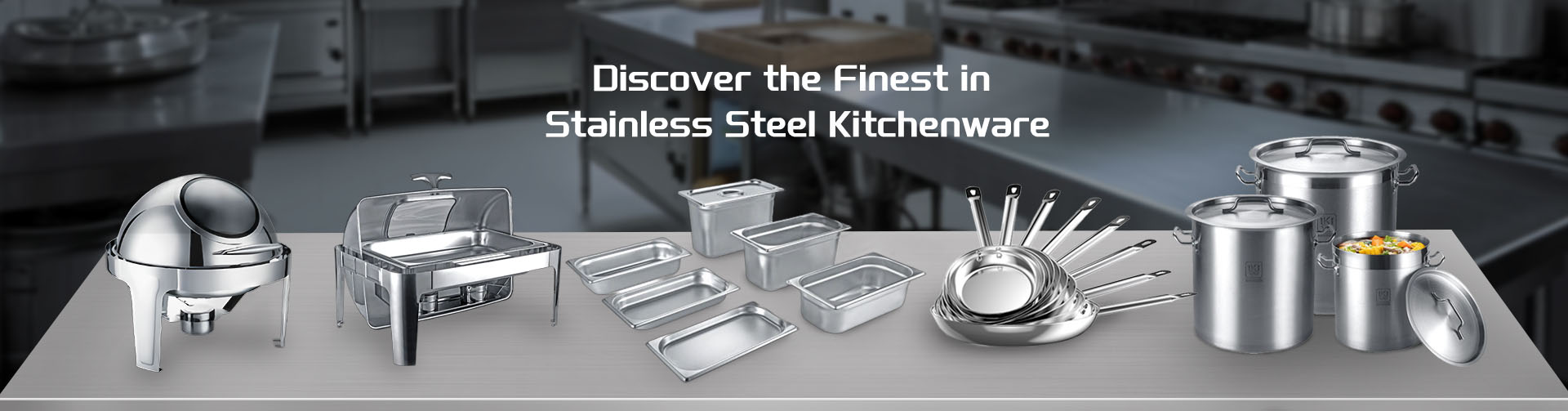
Our factory produces trolley carts alongside gn pans, Chafing Dishes, stock pots, Stainless Steel Barrels, and beverage dispensers. Buyers can review our commercial kitchenware range before planning a coordinated order.
OEM or ODM changes should be reviewed against tray size, balance, overall dimensions, production feasibility, and shipping volume. A drawing and sample approval are especially valuable when the trolley must fit existing trays or a fixed kitchen route.
Have a kitchen layout or tray specification ready? Click here to discuss a custom tray trolley quotation. Send us the tray dimensions, required capacity, trolley quantity, working environment, and delivery market so we can evaluate a single- or double-line configuration.