kelley@u-kitchenwares.com
+86-15819924651
+86-0750-3719388

stainless steel pots may warp or heat unevenly because of rapid temperature changes, excessive burner output, an unsuitable base structure, a mismatch between the pot and burner, manufacturing stress, or improper use. Uneven heating does not always mean the stainless steel is defective: stainless steel is durable and corrosion-resistant, but it conducts heat less efficiently than aluminum or copper.
Understanding how stainless steel cookware responds to heat helps commercial kitchens prevent distorted bases, hot spots, scorched food, and unstable contact with the cooking surface.
Heat enters a pot through its base and then moves into the food. If one section of the base receives much more energy than another, that area expands faster.
Metals expand when heated and contract when cooled. If expansion occurs unevenly or too quickly, stress develops across the base. Repeated severe stress may leave the pot temporarily or permanently distorted.
A commercial pot must therefore combine suitable materials, construction, burner use, and operating technique.
An empty stainless steel pot can become extremely hot in a short time, especially on gas, induction, or high-output commercial ranges.
Without food or liquid to absorb the energy, the center of the base may heat much faster than the surrounding metal. This creates thermal stress and can lead to discoloration or warping.
Preheat only when the cooking process requires it. Use controlled heat and add the intended cooking medium before the pot becomes excessively hot.
Thermal shock occurs when a hot pot is cooled abruptly. Examples include placing a hot pot under cold water or setting it on a very cold surface.
The outer and inner areas of the metal do not contract at exactly the same rate. A sudden temperature difference can distort the base or weaken bonded construction over time.
Allow cookware to cool sufficiently before washing. This is particularly important for pots with composite or encapsulated bases.
A small burner beneath a very wide pot concentrates heat in the center. The middle may become hot while the outer area remains relatively cool.
An oversized flame can create a different problem: heat travels around the base and up the sides, potentially overheating handles and wasting energy.
For more even heating:
Match burner diameter to the pot base
Center the pot on the heat source
Avoid flames extending beyond the base
Use moderate output until food begins heating
Stir dense products regularly
Rotate cookware only when the operating procedure safely permits it
A very thin single-layer stainless steel base reacts quickly to localized heat. That may be useful in some applications, but it can also create pronounced hot spots.
Commercial pots often incorporate a conductive aluminum layer in the base. Aluminum spreads heat faster than stainless steel, helping distribute energy across a broader area. The stainless steel layers provide durability and a practical cooking surface, while the conductive core improves thermal response.
Not all composite bases perform identically. Core thickness, coverage, bonding, flatness, and manufacturing consistency influence the result.
Induction cooking heats a magnetically responsive layer through an electromagnetic field. The cookware must be compatible with the induction system, and the base must make stable contact with the cooking zone.
A pot that is much smaller or larger than the induction zone may heat irregularly. Existing base distortion can worsen contact and cause cycling or reduced performance.
Buyers should confirm:
Induction-compatible exterior material
Minimum and maximum supported pot diameter
Base flatness
Equipment power
Control settings for large-volume cookware
Thick sauces, porridge, dairy products, and high-solids mixtures transfer heat differently from water. Food near the bottom may overheat while the upper volume remains cooler.
Even a well-designed pot cannot eliminate the need for correct cooking technique. Lower heat, frequent stirring, and an appropriately wide vessel can improve consistency.
For reductions and products that require constant access, a sauce pot may perform better than a tall stock pot.
No. Some cookware bases are designed with a slight profile that changes as the metal heats. Manufacturing tolerances must distinguish between an intentional design and a defective rocking or spinning condition.
Check the pot when it is clean and at room temperature on a verified flat surface. If it rocks significantly, spins easily, or loses stable contact during normal heating, remove it from service for evaluation.
A minor visual variation does not necessarily affect performance, while severe distortion can create a tipping hazard or poor heat transfer.
Begin at low or moderate heat, especially with an empty or lightly filled pot. Increase output after the contents begin absorbing heat.
Do not allow liquid to evaporate completely. Dry boiling can overheat the vessel, damage the surface, and create severe thermal stress.
Move the pot away from the burner and allow it to cool naturally. Do not attempt to accelerate cooling with cold water.
Use a stock pot for high-volume liquid preparation and a wider sauce pot for recipes requiring reduction or frequent stirring.
Overloading increases cooking time and creates handling hazards. Maintain sufficient headspace and follow the kitchen’s lifting procedures.
Look for rocking, separation, severe discoloration, cracks, loose handles, or unusual sounds during heating. Remove questionable cookware until it has been assessed.
A reliable export supplier of stainless steel commercial cookware should provide clear construction details instead of relying on general claims such as “heavy duty.”
A purchasing specification should state:
Stainless steel grade
Body and lid thickness
Base-layer construction
Conductive core material and thickness
Pot diameter and height
Working capacity
Handle design
Heat-source compatibility
Flatness expectations
Inspection method
Packaging protection
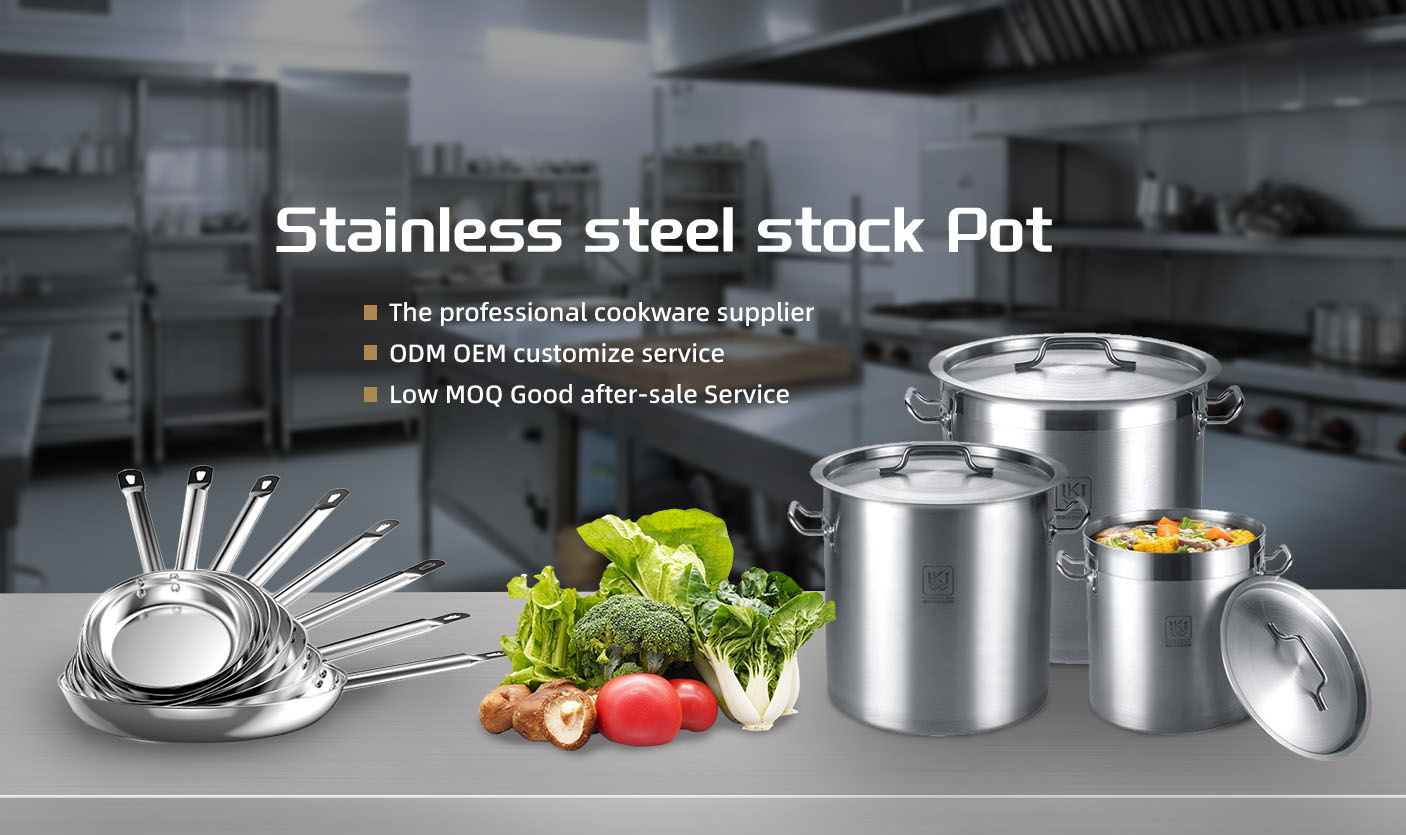
Our factory supplies Stainless Steel Stock Pots, sauce pots, soup pots, strainers, and related commercial kitchenware. We can review product size, body construction, composite base, handle attachment, finish, lid, logo, and packaging for standard and customized orders.
Production control covers material checking, forming, base assembly, handle installation, surface inspection, dimensional verification, and final packing. For a bulk order, an approved sample provides a physical reference for construction and workmanship.
When a stainless steel pot heats unevenly:
Confirm that the pot is centered.
Compare the burner and base diameters.
Reduce excessive heat.
Check whether the recipe needs more stirring.
Inspect the base for rocking or distortion.
Verify induction compatibility where applicable.
Test another pot on the same burner.
Test the affected pot on another suitable burner.
Remove the pot from service if instability or base separation is found.
This sequence helps distinguish cookware problems from heat-source or operating problems.
Stainless steel pots warp or heat unevenly when thermal expansion is poorly controlled or heat is concentrated in one area. Empty high-heat operation, thermal shock, undersized burners, unsuitable base construction, and dense foods are common contributing factors.
A well-constructed composite base can improve heat distribution, but correct use remains essential. Match the pot to the burner, heat it gradually, stir appropriately, avoid dry boiling, and allow it to cool before washing. Those habits protect cookware performance and improve consistency in a busy commercial kitchen.