kelley@u-kitchenwares.com
+86-15819924651
+86-0750-3719388

In many high-volume kitchens, the real cost of food pans is not found on the purchase order. It appears later, during the monthly equipment check. A chef may set aside pans with bent rims. A buffet team may complain that lids no longer sit flat. A dishwashing team may notice rust marks or sharp curled edges. At first, these problems look small. After a few months, they become another replacement order.
For hotels, catering kitchens, central kitchens, buffet suppliers, and foodservice distributors, stainless steel gastronorm pans should be judged by how long they stay usable under daily pressure. A low unit price may look attractive, but if pans deform, rust, or lose their shape too quickly, the kitchen ends up buying the same item again and again.
Commercial kitchens rarely replace all pans at once. The cost builds slowly. One pan becomes uneven after repeated washing. Another does not stack properly. A third pan looks too worn for buffet service. Staff may keep using them for a while, but damaged pans make daily work less smooth.
In busy kitchens, gn pans are constantly moved between prep areas, cold storage, steam tables, buffet stations, dishwashers, and storage racks. They carry hot food, chilled ingredients, sauces, cooked dishes, and prepared portions. This repeated handling is exactly where weak pans begin to fail.
Durability matters because every damaged pan creates extra work. Staff need to separate it, replace it, report it, or work around it during service. Over time, the purchase price becomes less important than the replacement cycle.
A warped pan causes more trouble than many buyers expect. It may no longer sit correctly inside a Chafing Dish, warmer, or prep counter. The lid may not close properly. Stacked pans may lean or take up more shelf space. During buffet service, an uneven pan can also make the food station look less professional.
This is especially important for hotels and catering companies. Their food presentation must stay clean during long service hours. If pans do not sit flat, staff need to adjust them repeatedly. That is wasted time during the busiest part of the day.
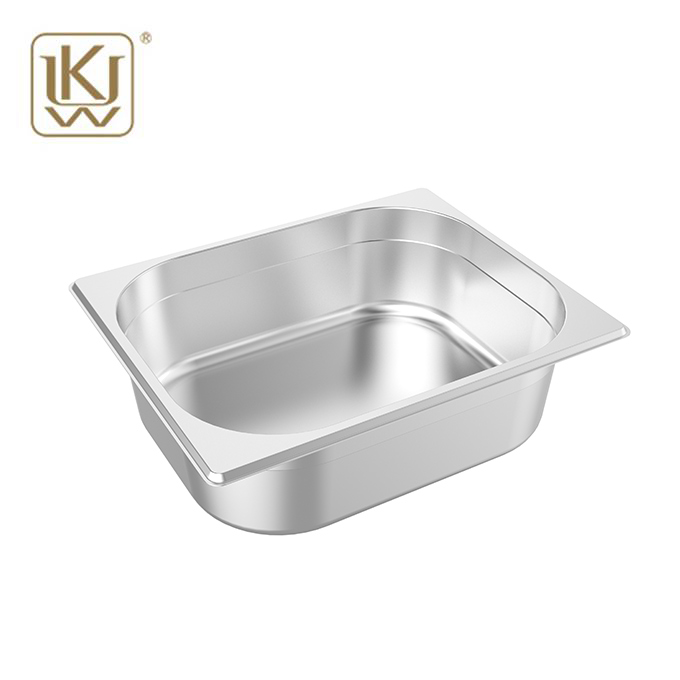
We are MEIJIN, and our 1/2 Stainless Steel Gastronorm Pan is designed for standard foodservice use, with practical GN sizing that helps kitchens move food between preparation, storage, and serving areas more easily.
High-volume kitchens are wet, hot, and fast-moving. Pans go through detergent, water, food acids, steam, hand washing, machine washing, and repeated stacking. If stainless steel quality or finishing is not stable, surface problems appear earlier.
Rust marks can make a pan unsuitable for visible buffet service. Curled rims can make stacking unstable. Rough edges may make handling uncomfortable for kitchen staff. Once these issues appear, the pan may still exist in the kitchen, but it is no longer trusted for daily service.
For foodservice distributors, these are exactly the problems that create customer complaints. A buyer may not complain after the first shipment, but if the pans wear out too quickly, they may not reorder.
Not every kitchen task needs the same pan depth. Shallow pans work better for display, quick service, and smaller portions. Deeper pans are more useful for storage, sauces, cooked ingredients, and batch preparation. If buyers use one depth for everything, pans may be overloaded, underused, or replaced faster than necessary.
For central kitchens and catering operations, the right depth helps control portioning, storage space, and service speed. For distributors, offering practical depth options gives customers a better way to match pans with their actual kitchen workflow.
This is why Stainless Steel Gastronorm Pans should be purchased according to real use, not only by size code. A buffet line, a prep kitchen, and a catering transport setup may all need different pan depths to work efficiently.
A strong food pan does not create value by looking new forever. It creates value by staying in rotation longer. If the rim stays stable, the surface remains easier to clean, and the pan keeps its shape after repeated washing and stacking, the kitchen can keep using it without constant replacement planning.
For procurement teams, this changes the buying logic. Instead of asking which pan is cheapest, the better question is which pan will still be usable after months of daily kitchen movement. That is where replacement cost becomes clearer.
Before a bulk order, buyers should review stainless steel quality, rim strength, surface finishing, available depths, lid compatibility, stacking stability, and packing protection. These details decide whether the pan can handle real kitchen pressure.
Durable GN pans can lower replacement costs because they reduce the problems that quietly remove pans from daily use: warping, rust marks, curled rims, unstable stacking, and poor lid fit. In high-volume kitchens, these details affect more than appearance. They affect workflow, service presentation, washing efficiency, and long-term purchasing cost.
If your kitchen or customer base keeps replacing pans because the rims bend, the surface wears too quickly, or the pans no longer stack cleanly, it may be time to review the pan itself rather than simply repeat the same order. For distributors and foodservice buyers, a better GN pan selection can turn a common kitchen consumable into a more stable repeat-purchase item.