kelley@u-kitchenwares.com
+86-15819924651
+86-0750-3719388

Custom stainless steel food pans are widely used in commercial kitchens, buffet counters, catering service, food processing areas, and centralized meal supply. For B2B buyers, the value of a food pan is not only in holding food. It also needs to fit kitchen equipment, support repeated cleaning, handle hot and cold environments, and stay stable during storage and transport.
Our 2/1 GN Pan belongs to the larger Gastronorm size range, making it suitable for large-volume food storage, buffet display, heat preservation, refrigeration, and kitchen transfer. For buyers sourcing a stainless steel gastronorm pan, the right custom details can reduce daily operation problems and make the product easier to use in different food service environments.
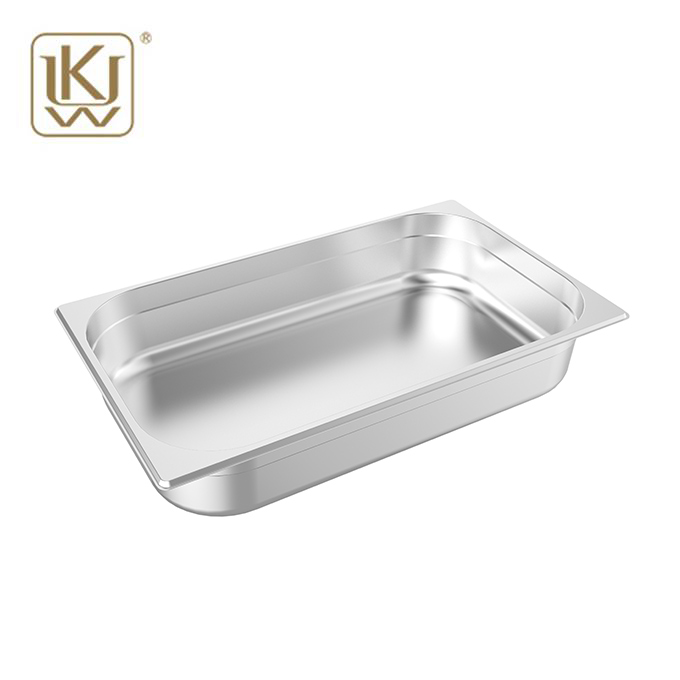
Material is the first detail buyers should confirm. Commercial kitchens often deal with steam, oil, salt, sauces, water, and frequent cleaning. Stainless steel is suitable for these conditions because it is strong, clean-looking, and easier to maintain than many other materials.
For restaurants, hotels, canteens, and catering companies, a food pan may move between preparation tables, refrigerators, ovens, buffet warmers, and washing areas. A good stainless steel food pan should remain practical under repeated use instead of becoming thin, weak, or hard to clean after a short period.
Custom food pans should be selected according to actual use. A shallow pan may be better for display, baking, cooling, or portion arrangement. A deeper pan is more suitable for soups, sauces, prepared ingredients, bulk storage, or food transfer.
For large kitchens and buffet operations, the GN system is helpful because it keeps pan sizes more organized across different equipment. When a pan fits steam tables, refrigerators, ovens, and storage racks properly, kitchen teams can move food with fewer containers and fewer handling steps.
For project buyers, size planning also affects storage space, loading quantity, and kitchen workflow. A wrong depth may lead to low capacity, poor display effect, or difficulty during daily service.
The edge of a food pan may look like a small detail, but it matters a lot in daily commercial use. A reinforced rim helps the pan stay more stable when it is lifted, moved, stacked, or placed into equipment. It also improves the hand feel when staff handle the pan during busy service hours.
Stacking is another key point for distributors and bulk buyers. If the edge is not well controlled, pans may get stuck together, tilt during storage, or deform during transport. For commercial kitchens, smooth stacking saves space. For importers and wholesalers, it also helps reduce carton damage and storage pressure.
Food pans are used with oil, sauces, cooked food, raw ingredients, and seasoning. If the surface is rough or difficult to wipe, kitchen staff will spend more time cleaning after service. A smooth stainless steel surface helps reduce food residue and keeps the pan suitable for repeated washing.
For hotel buffets and open food display areas, the surface also affects presentation. Clean stainless steel gives a professional look and helps food service areas appear more organized. For hospitals, schools, and canteens, easy cleaning is closely linked with daily hygiene management.
Different buyers need different food pan details. Restaurant kitchens may focus on fast preparation, food holding, and easy transfer between stations. Hotel buffets may care more about appearance, stable heat preservation, and smooth display. Catering companies need pans that can handle transport, temporary storage, and repeated loading at different venues.
Food processing plants may use stainless steel food pans for semi-finished product storage, cooling, packaging preparation, and internal transfer. School and hospital canteens may use them for centralized meal preparation, serving, washing, and disinfection. These different scenarios should guide the choice of size, depth, edge design, surface finish, and packaging.
For wholesale buyers, packaging is not just a shipping detail. Stainless steel pans have visible surfaces and shaped edges, so poor packing can cause scratches, dents, or deformation during long-distance transport. This can increase after-sales cost and affect customer confidence.
Custom packaging can be planned according to the sales channel. Bulk project orders may need stronger export cartons and better protection between pans. Retail or distributor orders may need labels, barcodes, instruction sheets, or market-ready packaging. Good packaging helps protect both the product and the buyer’s delivery reputation.
The most important details in custom stainless steel food pans include material, size, depth, rim structure, surface finish, stacking performance, cleaning convenience, application fit, and packaging protection. For restaurants, hotels, catering companies, food processing plants, and wholesale distributors, these details directly affect daily use and long-term purchasing value.
If you are planning a custom stainless steel food pan order, you can send us your target application, required size, usage environment, and packaging needs. We can help you review the details and suggest a practical solution for your commercial kitchen, catering, buffet, or bulk supply project.