kelley@u-kitchenwares.com
+86-15819924651
+86-0750-3719388

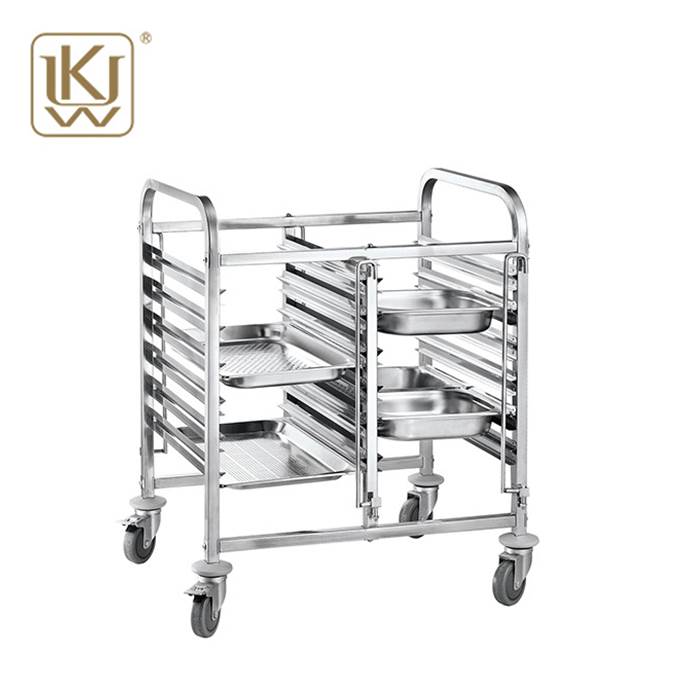
Dents and scratches on a stainless steel trolley cart usually come from daily impacts, overloaded trays, rough floor transitions, or accidental collisions with door frames and equipment. The good news is that most surface marks can be improved significantly, and minor dents can often be reduced without compromising the cart’s usability. The key is to choose a repair method that matches the damage type, the stainless steel finish, and the structural location, so you improve appearance while avoiding new deformation, discoloration, or corrosion risk.
This guide explains practical repair steps for common damage scenarios on stainless trolley carts, and it also highlights prevention habits that reduce repeat damage. KW supplies commercial-grade stainless steel tray trolley solutions designed for demanding environments where carts are moved, loaded, cleaned, and reused continuously.
Before using any tool or abrasive, check what you are dealing with. Stainless steel damage is not always the same, and using the wrong method can turn a small mark into a visible patch.
Hairline scratches are shallow and usually affect only the top surface finish
Scuff marks are often transfer marks from rubber, aluminum, or painted surfaces and may not be true scratches
Deep scratches can catch a fingernail and may cut through the finish layer
Small dents usually come from point impacts and may be improved if the panel has access from behind
Creased dents or dented corners involve stretched metal and are harder to fully restore
Also check the finish direction. Many trolley carts have a brushed grain. Repairs should follow that grain direction to avoid creating swirl patterns.
Even simple scratch repairs can go wrong if the cart is dirty or if tools are too aggressive.
Clean first Remove grease and debris using a mild detergent and water, then dry the area completely. Dirt trapped under an abrasive pad can create new scratches.
Protect nearby edges and joints Use masking tape to protect adjacent seams, corners, rivets, and welded zones. These areas can polish differently and may show contrast if overworked.
Work with controlled pressure Stainless steel shows pressure marks easily. Light, consistent pressure produces a more uniform finish than heavy force.
Always test on a hidden area Test pads or compounds on an underside section first to confirm the finish match.
Many marks that appear to be scratches are actually surface transfers.
Apply a small amount of stainless-safe cleaner or isopropyl alcohol on a soft cloth
Rub gently along the grain direction, not in circles
If the mark persists, use a non-abrasive sponge and mild detergent, then rinse and dry
If the mark disappears without changing the finish, it was likely a scuff transfer rather than a scratch. This is the best outcome because it preserves the factory finish.
For hairline scratches on brushed surfaces, the goal is to blend the scratch into the existing grain.
Choose a fine abrasive pad Use a fine-grade pad suitable for stainless steel. Avoid coarse pads because they can create wider scratches than the original defect.
Match the grain direction Move the pad in straight strokes along the same direction as the brushed finish. Short, repeated strokes are easier to control than long sweeping motions.
Feather the repair area Do not focus only on the scratch line. Blend into a slightly larger area around it so the transition looks natural.
Finish with a polishing compound Use a stainless polishing paste to restore uniform sheen, then wipe clean and dry.
This method works best when scratches are shallow and the metal is not gouged.
Deep scratches are difficult to eliminate completely because they remove material. The practical target is to reduce visibility while keeping the surrounding finish consistent.
Start with a slightly more aggressive stainless-safe abrasive than used for hairline scratches
Keep strokes strictly aligned with the grain
Gradually step down to finer abrasives to remove the marks left by the previous step
End with a polishing compound to even out reflectivity
If the scratch is near a high-visibility panel, aim for consistency rather than perfection. Overworking one small spot often creates a shiny patch that looks worse than the original scratch.
Dent repair depends on whether you can access the back side of the dent and whether the metal is stretched.
If the trolley panel can be reached from behind:
Support the area around the dent with a flat backing surface
Use a rubber mallet or a rounded pushing tool to apply gradual pressure from the back
Work from the outer edge of the dent toward the center to reduce the risk of creating a raised spot
Check alignment frequently under angled light
If you cannot reach behind the panel:
Cosmetic improvement is limited
Avoid aggressive pulling methods that can distort thin stainless panels
Focus on smoothing sharp edges rather than trying to fully remove the dent
If the dent is on a structural point such as a load-bearing shelf edge, wheel mount zone, or frame corner, do not attempt heavy reshaping. Structural distortion can affect stability and rolling behavior.
Some damage is cosmetic, while other damage affects function. A trolley cart should remain safe to push, stable under load, and easy to clean.
Consider replacement or professional repair when:
The dent causes trays to sit unevenly or slide
The frame no longer rolls straight or wobbles under load
Welded joints show cracks or separation
The damage creates sharp edges that can cut hands or tear packaging
Corrosion appears around the damaged zone due to surface breakdown
In high-traffic environments, performance consistency matters more than perfect appearance. A reliable cart should remain stable and smooth even after repeated cycles.
After scratch or dent work, residue from abrasives and compounds must be removed.
Wash the repaired area with mild detergent and warm water
Rinse thoroughly and dry fully to prevent water spots
Apply a stainless conditioning product if used in your facility to improve appearance consistency and reduce fingerprints
Maintain regular cleaning intervals to prevent mineral deposits from becoming permanent marks
Keeping the surface dry after cleaning is one of the simplest ways to maintain long-term appearance.
Repairs help, but prevention reduces maintenance cost and downtime.
Avoid dragging heavy trays or sharp-edged bins across shelves
Use controlled loading to prevent sudden impacts on corners
Keep wheel paths clear of debris and hard bumps that cause frame collisions
Train staff to push from stable handle zones rather than striking the cart sideways
Use routine checks for loose casters that can cause vibration and impact damage
The more stable the rolling and frame structure is, the less likely the cart will suffer repeated impact damage.
Removing dents and scratches from a stainless steel trolley cart starts with identifying whether the mark is a surface transfer, a light scratch, a deep scratch, or a dent that affects the metal shape. Light scratches can often be blended by matching the brushed grain direction and finishing with a suitable polish, while deeper scratches should be reduced carefully to avoid creating visible finish patches. Small dents may be improved when back access is available, but structural areas should be handled conservatively to protect stability and safe operation.
With the right repair approach and prevention habits, a stainless trolley cart can maintain a clean, professional appearance and dependable performance over long service cycles, especially in environments where carts are used continuously.