kelley@u-kitchenwares.com
+86-15819924651
+86-0750-3719388

Food waste in commercial kitchens is rarely caused by one big mistake. More often, it comes from small problems repeated every day. Soup burns slightly at the bottom during one batch. Sauce reduces too fast in another. Heat spreads unevenly, so staff stir more, monitor more, and still lose part of the product. Over time, those small losses become real cost pressure.
That is why cookware selection matters more than many buyers expect. In restaurants, hotels, school kitchens, catering operations, and central food preparation sites, the right stock pot does more than hold ingredients. It helps control heat, protect yield, improve batch consistency, and reduce avoidable waste during long cooking cycles.
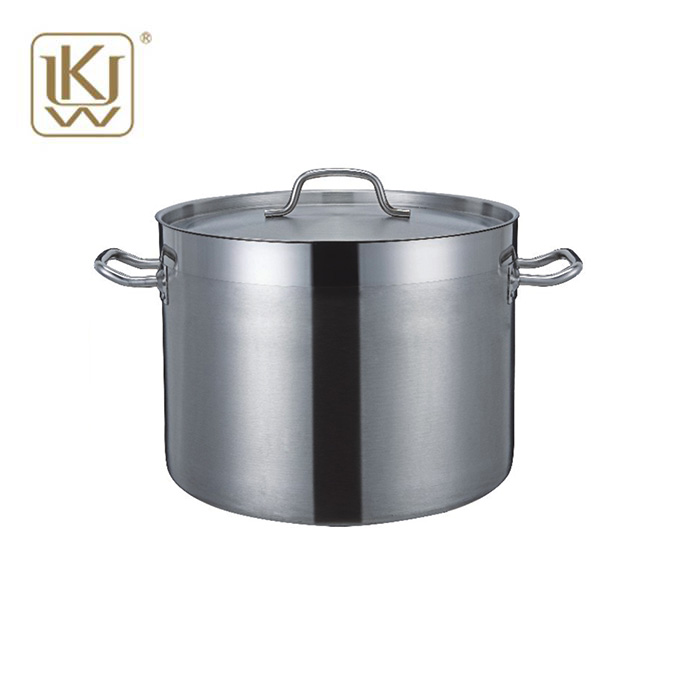
Our Stainless Steel Soup Pot With Lid is designed for this kind of professional use. It combines a durable stainless steel body, a fitted lid, and a composite bottom structure that helps kitchens handle soups, broths, sauces, and bulk cooking more efficiently. For importers, distributors, wholesalers, and project buyers, this is also the kind of product that fits well into a practical commercial cookware lineup.
In a professional kitchen, food waste often starts before service begins. If a pot heats unevenly, ingredients may cook too fast in one area and too slowly in another. Staff then need to adjust the fire, stir constantly, or transfer food earlier than planned. This increases labor and still does not fully solve the problem.
The issue becomes more serious with soup, stock, stew, and sauce. These foods are often prepared in volume and held over a longer period. If heat concentration is poor, ingredients can stick to the bottom, liquid can reduce too quickly, and flavor balance becomes harder to control. Once that happens, part of the batch may no longer meet the standard needed for service.
For B-end buyers, this is an important point. A stock pot should not be seen as a simple container. It is a working tool that affects output, consistency, and ingredient cost. Choosing the wrong pot may save money at the purchasing stage, but it often creates more loss during daily use.
A good stock pot helps reduce waste by creating a more stable cooking environment. When heat moves more evenly through the base, the product cooks in a more controlled way. Staff spend less time reacting to hot spots, and the risk of scorching or over-reduction becomes lower.
This matters especially for large-batch cooking. In a busy restaurant or catering kitchen, one batch may serve dozens of people. If even a small percentage is lost from sticking, burning, or excessive evaporation, the waste is no longer minor. It affects food cost directly.
Our product uses a composite bottom structure with an aluminum layer designed to improve heat transfer. That gives the pot a practical advantage for kitchens that need steady heating across longer cooking periods. When heat distribution is more balanced, it is easier to keep soups, broths, and sauces in better condition from the beginning of the process to the final serving stage.
This is one reason large restaurant cooking pots remain an important purchase category for commercial kitchens. They are not just about size. They are about handling volume without losing control.
Many buyers focus on pot material and capacity first, but lid design also plays an important role. In commercial cooking, a well-fitted lid helps retain heat, reduce unnecessary evaporation, and protect flavor during longer simmering processes.
Without a proper lid, kitchens often lose more liquid than expected. Staff then need to add more water or stock, which can weaken flavor consistency. In soup preparation, that can mean extra seasoning adjustments and less predictable final results. In sauce production, it may mean the batch thickens at the wrong speed or becomes too concentrated.
Our Stainless Steel Soup Pot comes with a lid designed to support heat retention and help maintain the original cooking condition more effectively. For busy kitchens, this makes daily production more stable and easier to repeat. For buyers supplying hotels or institutional kitchens, this also adds practical value because the lid is part of what helps the pot perform well in real use, not just in a catalog description.
Not every commercial kitchen works at the same scale. A café kitchen may need one size for soup of the day, while a hotel or banquet kitchen may need much larger volume for stock, stew, or event service. That is why capacity range matters in procurement.
Our product line covers multiple sizes, from 14L up to 113L. This gives buyers more flexibility when building a cookware program for different end users. Smaller capacities can support daily restaurant production, while larger options are better suited for hotels, school canteens, food processing, and banquet kitchens.
For importers and wholesalers, this is a strong selling point. A broader size range makes it easier to serve different market segments with one consistent product family. It also supports mixed orders, which many distributors prefer when building a more complete commercial-grade offering.
For professional kitchens, choosing the right capacity is not only about output. It also affects waste control. A pot that is too small may force repeated batches and inconsistent results. A pot that is too large for the task may waste energy and make portion planning less efficient. Having the right size available is part of reducing operational loss.
Material choice has a direct effect on durability, hygiene, and long-term value. Stainless steel continues to be the preferred option in commercial kitchens because it performs well under repeated daily use and is easier to maintain than many alternatives.
Our product uses 304 stainless steel, which is widely accepted in professional food-contact applications. For kitchen operators, this means a pot that can handle repeated exposure to water, seasoning, and heavy use more reliably. For buyers, it means the product is easier to position as commercial-grade cookware rather than entry-level kitchenware.
A Stainless Steel Stock Pot also supports cleaning efficiency. In high-turnover kitchens, equipment needs to be cleaned quickly and returned to use without unnecessary maintenance trouble. This matters not only for labor efficiency but also for hygiene management in schools, hospitals, hotels, and large foodservice operations.
Food waste is not only about ingredients thrown away. It is also about wasted labor. When a pot is difficult to control, kitchen staff must spend more time stirring, monitoring, correcting temperature, or reworking the batch. That reduces overall productivity, especially during peak production periods.
A more stable stock pot helps solve this by reducing the number of manual corrections needed during cooking. With better heat transfer and a more practical structure, staff can work more confidently and spend less time dealing with preventable problems.
This is particularly important in professional kitchens with limited staff. When labor is already tight, equipment should make the process easier, not harder. A well-chosen stock pot helps keep production moving with fewer interruptions, which supports both kitchen efficiency and output consistency.
That is another reason large restaurant cooking pots should be selected carefully. Buyers are not only purchasing volume. They are purchasing a tool that affects how smoothly the kitchen can work every day.
A stock pot that works well in one commercial scenario often has value across many others. Restaurants use it for soup, stock, stew, and sauce preparation. Hotels need it for breakfast service, banquet preparation, and back-of-house production. School and university kitchens value it for larger daily meal volumes. Food processing sites may use it for syrups, sauces, or pre-cooked ingredients.
Our Stainless Steel Soup Pot With Lid fits naturally into these applications because it combines a commercial size range, durable construction, and a base structure designed for more even heating. For distributors and project buyers, this kind of versatility matters because it makes the product easier to recommend across different customer groups.
A product with broad application is also easier to build into a commercial cookware line. Instead of serving one narrow niche, it can support restaurants, hospitality, institutional kitchens, and bulk cooking environments at the same time.
Professional buyers tend to look beyond the pot itself. They want to know whether the supplier can support repeat orders, stable quality, and practical specifications. They also care about whether the product line is broad enough for long-term cooperation.
For wholesalers, consistency between shipments is often a top concern. For importers, packaging and order planning may matter just as much as material and capacity. For project buyers, the focus may be on suitability for school, hotel, or foodservice tenders. For brand owners, OEM or ODM support can make the difference between a standard product and a market-ready product line.
This is why a stock pot like this should be presented as part of a supplier solution, not only as an individual item. Buyers want products that solve operational problems and fit into a larger business plan.
In many markets, cookware buyers are building their own sales channels and product identities. OEM and ODM support make that easier by allowing the product range to align with local branding and market strategy.
For large restaurant cooking pots, OEM and ODM value can include private label support, packaging adjustments, coordinated size ranges, and matching cookware development across related categories. This helps importers, distributors, and solution providers create a more complete commercial offering instead of selling one-off generic items.
For buyers working with hospitality, institutional, or catering customers, that kind of flexibility is important. They often need products that look consistent across a line and support repeat ordering over time. A supplier that can support those needs is more valuable than one that only offers standard stock.
Commercial kitchens reduce food waste best when they control the process before waste happens. The right stock pot helps make that possible by improving heat distribution, supporting stable simmering, reducing unnecessary evaporation, and protecting the quality of each batch.
A well-designed stainless steel soup pot is not only a cooking vessel. It is part of the kitchen’s efficiency system. Our stainless steel soup pot with lid is built for that purpose, with 304 stainless steel construction, a practical lid, a composite bottom, and multiple capacity options that fit different commercial needs.
If you are sourcing cookware for restaurants, hotels, schools, catering projects, or private label programs, feel free to contact us. We can help you review size selection, application matching, and OEM or ODM options so you can choose a solution that works better for your market and your customers.