kelley@u-kitchenwares.com
+86-15819924651
+86-0750-3719388

Efficiency in food service is not only about speed. It is about how smoothly work flows from preparation to serving, how safely staff handle hot liquids, and how consistently products are delivered. In this process, equipment design plays a critical role. A well-designed stock pot with spigot can significantly improve daily operations by reducing unnecessary handling and simplifying liquid dispensing.
In many commercial kitchens, large volumes of soup, broth, sauce, or hot beverages are prepared every day. Traditional stock pots are capable of handling volume, but they do not solve the problem of transferring hot liquid efficiently. Staff still need to lift, tilt, or ladle the contents, which increases labor time and creates safety risks. This is where a stock pot with spigot becomes a practical upgrade rather than just an alternative option.
In high-volume kitchens, even small inefficiencies can slow down the entire operation. When a large pot needs to be lifted or tilted to pour liquid, it interrupts the workflow and requires additional attention from staff. This becomes more noticeable during peak service hours.
With a stock pot with spigot, liquid can be released directly from the vessel in a controlled way. This eliminates the need for repeated scooping or heavy lifting. Staff can move from cooking to serving more smoothly, especially when preparing multiple batches. For catering services, central kitchens, and buffet setups, this kind of efficiency directly affects service speed and consistency.
The ability to dispense liquid without moving the entire pot also improves portion control. Instead of estimating each serving manually, operators can achieve a more consistent output, which is important for cost control and standardized service.
Handling hot liquid is one of the most common challenges in food preparation. Large volumes increase both physical strain and safety concerns. Lifting a full pot requires strength and careful coordination, especially in fast-paced environments.
A stock pot with spigot reduces the need for manual handling. Instead of lifting, staff can simply open the valve to release the liquid. This lowers the risk of spills and minimizes strain on workers. In commercial kitchens where efficiency and safety must work together, this design offers a clear advantage.
For buyers supplying restaurants, catering companies, or institutional kitchens, this feature is often a key selling point. Equipment that improves safety usually leads to better long-term user satisfaction and fewer operational issues.
Consistency is essential in food service. Whether it is soup, sauce, or beverage preparation, each batch should meet the same quality and portion standards. Inconsistent handling can lead to waste, uneven serving sizes, and customer dissatisfaction.
A stock pot with spigot helps maintain better control during dispensing. The steady flow allows for more accurate portioning, which supports consistent output across different shifts and staff members. This is especially important in large-scale operations where multiple people are involved in the preparation process.
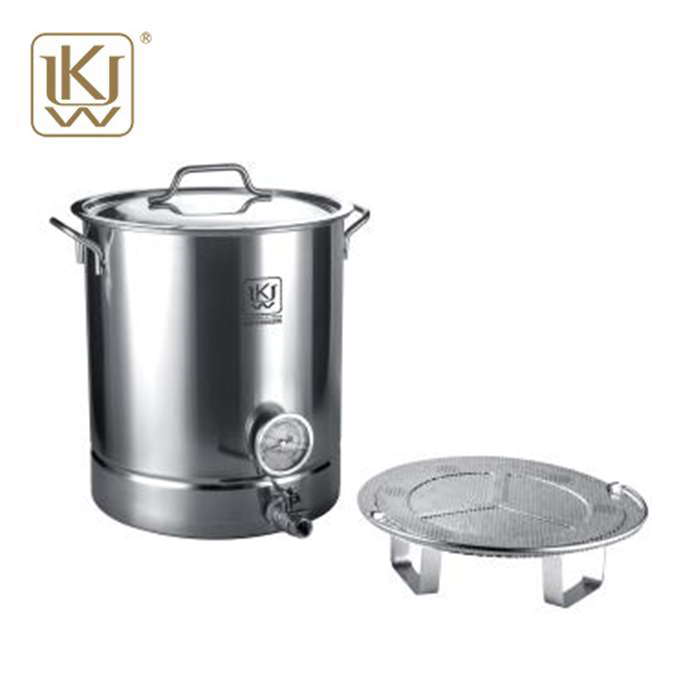
Consistency also extends to temperature management. Our product is designed with a built-in thermometer, allowing operators to monitor heat levels more precisely during cooking or brewing. This feature is useful for applications that require controlled temperatures, such as broth preparation or beverage processing.
Efficiency improvements only matter if the product can handle daily use. Commercial kitchens require equipment that is durable, easy to clean, and reliable over time.
Our product is made from 304 stainless steel, which provides strong resistance to corrosion and heat. It is available in multiple capacities, including 32L, 40L, and 64L, making it suitable for different production scales. The body thickness of 1.0–1.2 mm offers a balance between strength and usability, while TIG welding ensures stable construction and clean finishing.
These features make the product suitable not only for brewing but also for a wide range of food service applications. The combination of material quality and functional design allows a stock pot with spigot to perform consistently in demanding environments.
While originally popular in brewing setups, this type of pot is increasingly used in broader food service scenarios. It can be applied in soup preparation, sauce production, hot beverage dispensing, and bulk liquid handling.
For distributors and product managers, this flexibility creates more opportunities in the market. A single product can serve multiple customer segments, including restaurants, catering services, beverage operations, and food processing environments. This helps reduce product overlap and simplifies inventory planning.
A stock pot with spigot is not limited to one use case. Its design allows it to adapt to different workflows, which makes it more valuable for buyers looking to expand their product lines.
For many importers and wholesalers, product selection is not only about function. It is also about how well the product fits their brand strategy and target market.
A stock pot with spigot offers strong potential for OEM and ODM projects. Buyers can customize capacity options, packaging, branding elements, and product positioning based on their market needs. This flexibility helps create a more competitive product offering and supports long-term business growth.
Working with a supplier that understands these requirements is important. Consistent production quality, clear specifications, and the ability to adapt to different market demands are key factors in successful sourcing.
Professional buyers are focused on practical results. They look for products that improve efficiency, reduce risk, and offer stable performance over time. A stock pot with spigot meets these expectations by combining functionality with reliability.
Instead of relying only on basic cookware features, it provides a solution that addresses real operational challenges. This makes it easier for distributors and suppliers to present the product as a commercial-grade solution rather than a standard kitchen item.
Improving food service efficiency often comes down to choosing the right tools. A well-designed stock pot with spigot helps streamline workflow, reduce manual effort, and support consistent production. It is a practical upgrade for kitchens that handle large volumes of liquid and need better control during preparation and serving.
For buyers looking to expand their product range or develop a more competitive offering, this type of product also provides strong potential in OEM and ODM applications. With the right supplier support, it can be adapted to different markets and customer needs.
If you are evaluating this category or need guidance on selecting the right specifications for your business, feel free to reach out. We can support your sourcing process with practical recommendations and help you find a solution that fits your market.
Previous: