kelley@u-kitchenwares.com
+86-15819924651
+86-0750-3719388

A Stainless Steel Brewing Pot is the foundation of a reliable homebrewing setup. It determines how smoothly you can heat the wort, how evenly you maintain the boil, and how easily you can control hop additions, chilling, and transfer without contamination. When selecting a brewing pot for Russian users, the best choice is not only about liters. Climate, heating methods, apartment kitchen layouts, and local water hardness often influence what features feel most practical in daily brewing.
This guide explains how to choose a Stainless Steel Beer Brewing Pot with a clear focus on real brewing workflow, durability, and compatibility with common Russian brewing environments. You can explore UKW options on our stainless steel beer brewing pot collection.
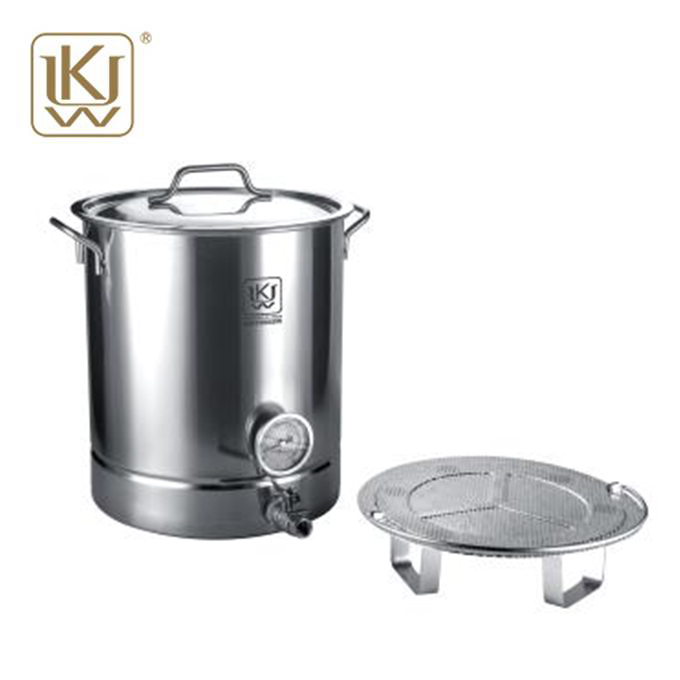
Brewing pot size should be chosen from your target finished beer volume, then expanded to include boil headspace. Boil overs happen easily during the hot break, especially on high-power burners. A pot that is too small forces you to lower heat, reduces evaporation control, and increases the risk of messy foam overflow.
For many homebrewers, a good rule is to choose a pot that is 25 to 40 percent larger than your target pre-boil volume. This headroom supports stable boiling, better hop utilization, and easier stirring. It also makes it safer to manage strong boiling when brewing in colder seasons, where users may push heating power higher to reach boil quickly.
| Target Finished Batch | Typical Pre-Boil Volume | Recommended Pot Size |
|---|---|---|
| 10 L | 12 to 14 L | 16 to 20 L |
| 20 L | 24 to 28 L | 30 to 40 L |
| 30 L | 36 to 42 L | 50 to 60 L |
| 50 L | 60 to 70 L | 80 to 100 L |
This sizing approach reduces frustration and makes the pot usable across multiple beer styles, including higher gravity brews that foam more aggressively.
Heat source compatibility is often the hidden deciding factor. Many brewers in Russian apartments rely on electric cooktops, while some hobby setups use gas burners or outdoor propane burners. A pot that is too wide for a burner zone heats slowly and can create uneven simmering around the edges. A pot that is too tall and narrow can take longer to reach boil and may be less stable on smaller stovetops.
For electric and induction environments, base flatness and contact area matter. A heavy, well-constructed base improves heat transfer and reduces hot spots that can scorch wort sugars. For gas burners, sturdy walls and handles matter because the pot is often moved while hot, and flame exposure can heat sidewalls more aggressively.
If your brewing setup is intended for both indoor and outdoor use, choose a pot shape and base design that remains stable on different burner types and stands securely when full.
Stainless steel is used in brewing because it is corrosion-resistant, easy to sanitize, and stable under repeated heating and cooling. For brewing pots, material quality becomes especially important when the pot is exposed to acidic wort, aggressive cleaning, and long-term storage in varying humidity.
A durable Stainless Steel Brewing Pot should resist pitting and discoloration, especially if local water has higher mineral content. In many areas, water hardness can increase scale formation on the pot surface. A smooth interior finish helps cleaning efficiency and reduces residue attachment after boiling.
Pot structure matters as much as material. Look at wall thickness, handle attachment, and how the rim is formed. A reinforced rim improves rigidity and reduces deformation. Strong handle construction matters because a full pot becomes heavy quickly, especially at 30 L and above.
Many brewers upgrade from a basic stockpot to a purpose-built brewing pot to improve workflow. A drain valve can simplify transfer to a fermenter and reduce splashing. A thermometer port can help monitor mash or pre-boil temperature, although many brewers prefer separate instruments for accuracy. Volume markings are useful for repeatability, particularly when tuning recipes and managing water-to-grain ratios.
However, more features are not always better. If you plan to use immersion chilling and whirlpooling, the internal geometry and outlet position matter. If you brew in a small kitchen, a valve must be positioned so it does not interfere with sink placement or storage.
In many cases, a custom brewing pot configuration is useful when you already know your brewing routine and want to reduce steps, especially for repeat production.
A lid is not only for covering. It affects heat retention, heating time, and how you manage steam in indoor brewing. In cold climates, brewers often prefer lids that fit cleanly to help reach boil faster. During boiling, many brewers keep the lid partially open to control condensation and volatile compound release.
A sturdy rim helps maintain shape when the pot heats, and it provides better lid seating. This becomes more important as pot diameter increases. If you brew indoors, consider your ventilation. Steam output can be significant during a full boil, so managing boil intensity and lid position becomes part of a practical brewing process.
Brewing demands sanitation. The pot itself is boiled, which provides a degree of sterilization, but residue and deposits still need proper cleaning after each batch. A smooth interior finish helps remove protein deposits and hop oils. Avoid surfaces that trap residue around welded joints or poorly finished fittings.
If your water is hard, routine descaling may be needed. Selecting a pot that cleans quickly reduces batch turnaround time and supports consistent beer flavor, because residue can contribute off-notes in later brews.
Space and handling are common constraints. A 50 L pot may be ideal for batch size, but if it cannot fit under a kitchen hood or cannot be safely lifted to pour, it becomes frustrating. Many brewers solve this by choosing a pot with a valve and transferring via tubing, reducing heavy lifting.
Handle spacing matters. Handles that allow a firm grip with heat-resistant gloves improve safety. A stable base reduces tipping risk, especially when stirring vigorously or performing whirlpool steps.
UKW provides stainless steel beer brewing pots designed for stable heating, clean sanitation routines, and reliable use across repeated batches. Our brewing pot options support practical selection by capacity, structure, and functional configuration. You can review available styles and specifications on our stainless steel beer brewing pot collection.
For projects that require branding, specific valve positions, or capacity standardization across multiple units, UKW can support configuration planning based on your brewing workflow and market expectations.
Choosing a stainless steel brewing pot for Russian users starts with batch volume and headroom, then focuses on heat source compatibility, stainless steel quality, structural durability, and workflow features such as valves and volume markings. A well-chosen pot makes boiling more stable, reduces boil-over risk, simplifies transfer and cleaning, and supports consistent brewing results across seasons and kitchen setups.
If you are selecting brewing pots for a retail program, brewing kit line, or bulk purchasing plan, contact UKW with your target capacity, heating method, and feature requirements. We can provide guidance on practical sizing and configuration to help you build a reliable brewing setup.
Previous: How To Use Steam Table Pans?