kelley@u-kitchenwares.com
+86-15819924651
+86-0750-3719388

gn pan size refers to the standardized dimensions used for gastronorm containers in professional kitchens. Instead of guessing whether a pan will fit a steam table, buffet station, prep counter, blast chiller rack, or combi oven tray, GN sizing creates a consistent footprint system so pans, lids, rails, and shelving match across equipment and brands. Once you understand the GN grid, you can select containers that stack correctly, portion efficiently, and move smoothly from prep to cooking to holding and service.
This guide explains what GN sizes mean, the most common GN pan dimensions, how depth changes capacity, and how to choose the right combination for your operation. To explore options, browse UKW’s GN Container range: GN pans
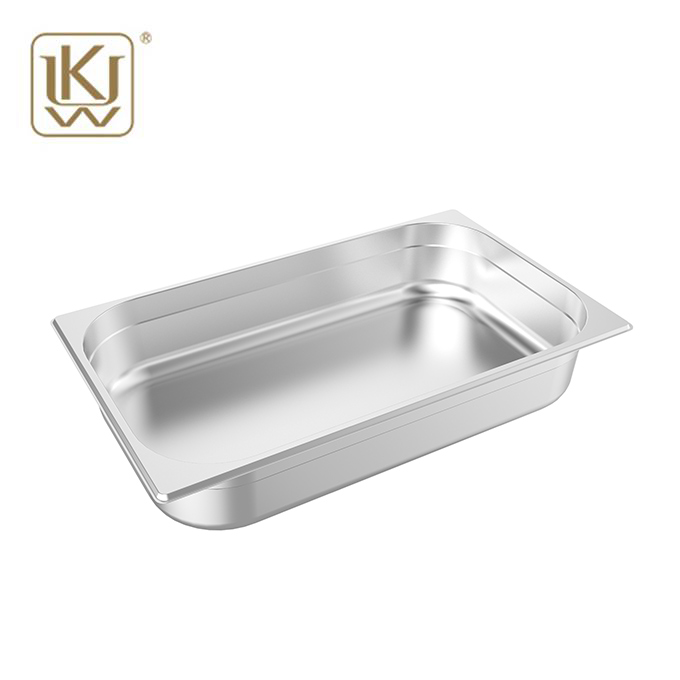
GN sizes are based on a modular rectangle. The “full size” is called GN 1/1, and smaller pans are fractional sizes that fit within the same footprint system. A key advantage is that different fractions can be mixed in one opening as long as their combined footprints equal the full GN layout. That is why GN pans are used everywhere in commercial kitchens, from ingredient mise en place to food display.
A GN size label has two parts:
The footprint fraction
Examples include GN 1/1, GN 1/2, GN 1/3, which describe the pan’s top dimensions.
The depth
Common depths include 20 mm, 40 mm, 65 mm, 100 mm, 150 mm, and 200 mm. Depth influences capacity and what foods the pan is best for.
Footprint tells you compatibility with equipment. Depth tells you how much food you can hold and how the product performs during heating, cooling, and service.
Below are widely used GN footprints and their top dimensions. These measurements matter most when you are matching pans to rails, cutouts, and racks.
| GN Size | Top Dimensions mm | Typical Use Case |
|---|---|---|
| GN 2/1 | 650 x 530 | High-volume prep, large batch holding |
| GN 1/1 | 530 x 325 | Standard steam tables, prep stations |
| GN 2/3 | 354 x 325 | Mixed service layouts, modular inserts |
| GN 1/2 | 325 x 265 | Half-size wells, ingredient holding |
| GN 1/3 | 325 x 176 | Toppings, sauces, smaller portions |
| GN 1/4 | 265 x 162 | Garnishes, condiments, small batches |
| GN 1/6 | 176 x 162 | Prep line inserts, frequent refills |
| GN 1/9 | 176 x 108 | Small toppings, herbs, samples |
In real kitchen planning, GN 1/1 and GN 1/2 are the most common “base” footprints, while GN 1/3, GN 1/6, and GN 1/9 are popular for inserts and fast-moving items.
Two pans with the same GN footprint can behave very differently if depth changes. Depth affects capacity, surface area exposure, cooling speed, and how easy it is to stir, scoop, or serve.
Shallow depths
Better for fast access, rapid cooling, thinner layers, and frequent replenishment.
Medium depths
Good general-purpose choice for hot holding, prep storage, and everyday service.
Deep pans
Useful for bulk holding, marinating, stews, large cuts, and reduced refill frequency.
A practical depth reference:
| Depth mm | Best Fit For | Notes For Daily Use |
|---|---|---|
| 20 to 40 | Sliced toppings, herbs, thin items | Fast access, minimal digging |
| 65 to 100 | Most hot-hold foods, prep storage | Balanced capacity and handling |
| 150 to 200 | Bulk ingredients, soups, large batches | Heavier when full, plan lifting |
If your team refills pans frequently, shallow pans can feel faster and cleaner. If you want fewer change-outs during service, deeper pans reduce labor but increase weight.
A “best” GN pan size depends on the equipment opening and the product you serve. Start with the space, then match the food behavior.
Key selection steps:
Confirm the equipment footprint
Identify whether your counter, steam table, or rack is built for GN 1/1, GN 1/2, or GN 2/1 layouts.
Decide how you want to split the well
A GN 1/1 opening can be one full pan, two GN 1/2 pans, three GN 1/3 pans, or a mix that fills the grid.
Match depth to refill rhythm
High-turn items often perform better in smaller or shallower pans to keep food fresher and easier to manage.
Consider temperature workflow
Deeper pans may cool slower and heat slower. Shallow pans react faster to temperature changes.
Plan for handling and safety
Very deep pans full of hot liquid can be heavy. Choose depth that fits your lift and transport routine.
One of the biggest benefits of GN sizing is the ability to mix different fractions in a single station. This helps you build efficient mise en place layouts and reduce wasted space.
Common combinations that fit a GN 1/1 opening:
2 x GN 1/2
3 x GN 1/3
4 x GN 1/4
6 x GN 1/6
9 x GN 1/9
Mixed layouts such as 1 x GN 1/2 plus 2 x GN 1/4
For sauce and garnish stations, mixed layouts are often the most efficient because you can allocate smaller pans to items that require freshness and frequent rotation.
GN sizing is about fit, but performance depends on construction details. When you standardize pans for a busy kitchen, you should also consider:
Lid fit and sealing
Tight, consistent lid fit reduces evaporation and helps with storage organization.
Stackability
Uniform rims and stable stacking reduce damage during storage and transport.
Edge and corner design
Smooth edges improve handling comfort and reduce cleaning time.
Perforated vs solid pans
Perforated pans are useful for draining and steaming, while solid pans are universal for holding and cooking.
If you purchase for multiple kitchens or outlets, consistent GN sizing and stable quality reduce replacement complexity and help simplify wholesale replenishment plans.
If you need a fast rule set, use this as a starting point:
Sauces, toppings, garnishes
GN 1/6 or GN 1/9, shallow to medium depth
Salad bar and buffet items
GN 1/2 or GN 1/3, medium depth for balanced capacity
Hot holding mains
GN 1/1, medium to deep based on turnover
Bulk prep and commissary storage
GN 2/1 or GN 1/1, deeper depths to reduce repacking
Steam and draining applications
Same footprint, choose perforated pans where drainage matters
GN pan size is a standardized footprint system that ensures your containers fit correctly across professional kitchen equipment. The footprint, such as GN 1/1 or GN 1/2, determines compatibility with rails and wells, while depth controls capacity and day-to-day handling. The smartest setup starts from your station layout, then uses a mix of fractions and depths to match turnover, temperature response, and service speed.
To view more gn container sizes, depths, and configurations, please browse UKW’s GN container range. If you are unsure which GN footprint and depth combination fits your equipment and menu flow, contact us with your station size and use scenario. UKW can provide selection guidance, support OEM/ODM customization, and help you standardize supply for consistent kitchen operations.