kelley@u-kitchenwares.com
+86-15819924651
+86-0750-3719388

Choosing the right sauce pot size is not only about how much liquid you can fit inside. The “right” size is the one that matches your batch volume, heat source, whisking space, evaporation needs, and service rhythm. If the pot is too small, sauces boil over, reduce too fast, and scorch more easily. If it is too large, heat spreads inefficiently, reductions take longer, and small batches can cook unevenly.
This guide explains how to choose a sauce pot size with clear, practical rules. It also includes a size reference based on common Stainless Steel Sauce Pot and sauce pan dimensions, so you can map real cookware measurements to your kitchen output.
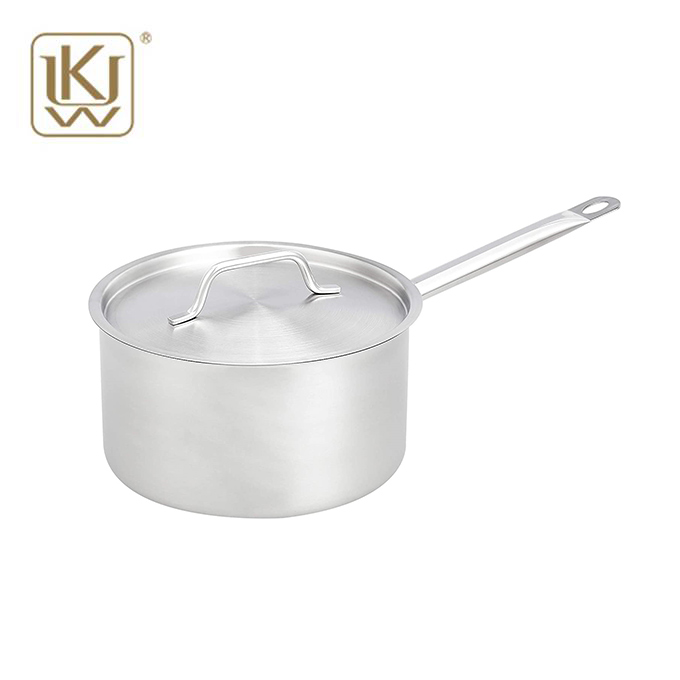
A sauce pot is used for tasks where control matters more than sheer capacity: emulsions, reductions, custards, gravies, syrup work, reheating sauces, and holding hot liquids during service. The pot size affects results in four important ways.
Heat distribution and burner match
A pot that is wider than the burner can develop hot rings and cooler centers, which makes thick sauces more likely to stick and burn.
Evaporation and reduction speed
Wider pots expose more surface area, so water evaporates faster and reductions concentrate quicker.
Whisking and stirring room
Sauces often need active movement. A pot that is too narrow forces aggressive stirring and increases splash risk.
Headspace for foam and bubbling
Many sauces expand while heating. The right pot prevents boil-overs and keeps your cooktop cleaner.
Before picking any model, calculate these two volumes.
Working volume
The amount of sauce you plan to cook or hold during a normal batch.
Safe fill volume
Working volume plus headspace, usually 20 to 30 percent more. This extra space prevents boil-over and makes whisking easier.
A simple rule that works in most kitchens is to select a pot whose total capacity is about 1.3 times your batch volume. If your batch is 3 liters, a pot around 4 liters is usually comfortable.
In many stainless steel lines, you will see two profiles that look similar but behave differently.
high body sauce pot
Taller walls reduce splatter and slow down evaporation. This shape is strong for simmering, reheating, and holding.
low body sauce pan
Shorter walls and wider surface exposure help reduce liquids faster and make whisking easier. This shape is strong for reductions, finishing sauces, and quick heat control.
If your work involves frequent reductions and finishing, the low body profile often feels faster. If you run larger volumes or do longer simmering, the high body profile can be more stable and cleaner.
These ranges assume you keep headspace and avoid filling to the brim.
1 to 2 liters
Best for small batches of gravy, pan sauces, reheating small portions, warm chocolate, and quick syrup.
2 to 4 liters
Best for daily kitchen volume: béchamel, cheese sauce, curry base, soup portions, and medium reductions.
4 to 8 liters
Best for service prep, batch cooking, and holding: bulk sauces, broth reheats, and multi-order output.
8 liters and above
Best for large-format production and centralized prep, especially when you want fewer batches and more consistent output.
If you often make thick sauces, choose the next size up. Thickness increases scorching risk, and extra room improves stirring control.
Capacity is only part of the story. Two pots can hold similar volume but cook very differently if one is wider and one is taller.
Wider diameter
Faster reduction, easier whisking, stronger sear on aromatics, more surface exposure.
Taller height
Lower evaporation, less splash, better heat retention, cleaner simmering.
If your goal is a glossy reduction, a wider pot can shorten cook time. If your goal is gentle heating and holding, a taller pot can protect texture and reduce mess.
The tables below use a simple cylinder estimate to translate diameter and height into approximate capacity. Real capacity can be slightly lower due to rim shape, internal curvature, and practical fill lines.
| Model | Dimension mm | Thickness mm | Approx Capacity L |
|---|---|---|---|
| SPI60095 | 160 x 95 | 0.8 | 1.91 |
| SPI80110 | 180 x 110 | 0.8 | 2.80 |
| SP200120 | 200 x 120 | 0.8 | 3.77 |
| SP220130 | 220 x 130 | 0.8 | 4.94 |
| SP240140 | 240 x 140 | 0.8 | 6.33 |
| SP260150 | 260 x 150 | 0.8 | 7.96 |
| SP280160 | 280 x 160 | 0.8 | 9.85 |
| SP300180 | 300 x 180 | 0.8 | 12.72 |
| Model | Dimension mm | Thickness mm | Approx Capacity L |
|---|---|---|---|
| SP160070 | 160 x 70 | 0.8 | 1.41 |
| SP180070 | 180 x 70 | 0.8 | 1.78 |
| SP200075 | 200 x 75 | 0.8 | 2.36 |
| SP220075 | 220 x 75 | 0.8 | 2.85 |
| SP240080 | 240 x 80 | 0.8 | 3.62 |
| SP260085 | 260 x 85 | 0.8 | 4.51 |
| SP280095 | 280 x 95 | 0.8 | 5.85 |
| SP300105 | 300 x 105 | 0.8 | 7.42 |
If you want a fast decision method, follow this sequence.
Write down your typical batch volume in liters.
Multiply by 1.3 to add working headspace.
Decide if you need faster reduction or gentler holding.
Choose a wider, lower profile for reduction-heavy work.
Choose a taller, higher profile for holding and simmering.
Match pot diameter to burner size so the base heats evenly.
If you run repeated batches, pick the size that reduces handling steps rather than the smallest possible fit.
Buying by liters only
A 4-liter pot can be wide or tall. The shape changes reduction speed and stirring comfort.
Filling too close to the rim
It increases boil-over risk and makes emulsions harder to control.
Using a wide pot on a small burner
It creates uneven heating and increases scorching risk in thick sauces.
Choosing a low body pan for long holding
It can lose heat faster and evaporate more than you expect.
Your sauce pot should be sized for control, not just capacity. Start with your batch volume, add 20 to 30 percent headspace, then choose the shape that fits your cooking style. Low body sauce pans help reductions move faster and make whisking easy. High body sauce pots are cleaner for simmering, reheating, and holding. When diameter matches your burner and the pot gives you enough room to stir safely, sauces become more consistent and easier to repeat.
To explore more size and spec options for stainless steel sauce pots and sauce pans, please browse UKW’s cookware range. If you are unsure which profile or capacity fits your workflow, contact us for selection support and steady supply.
Previous: What Is GN Pan Size?